
The Piano in the Parlour
The Piano in the Parlour
The house on Whitethorn Lane had been empty for three years before Alice unlocked the front door with a brass key that felt heavier than it should. Dust swirled in the October light, settling on furniture draped in sheets, and the air carried the faint, faded scent of lavender and rosin—the smell of her great-aunt Eleanor, who had died alone in a care home six months ago, leaving everything to a niece who had not visited once in the final year.
Alice was a music teacher now. She had spent her twenties running from the memory of a girl who could have been a concert pianist but had choked on stage at fourteen and never touched a serious piece again. Eleanor had been her first teacher, her fiercest champion, the one who told her that music was a kind of haunting—once a melody gets inside you, it never truly leaves. Alice had stopped taking her calls after the dementia diagnosis. It was easier than explaining who she had become.
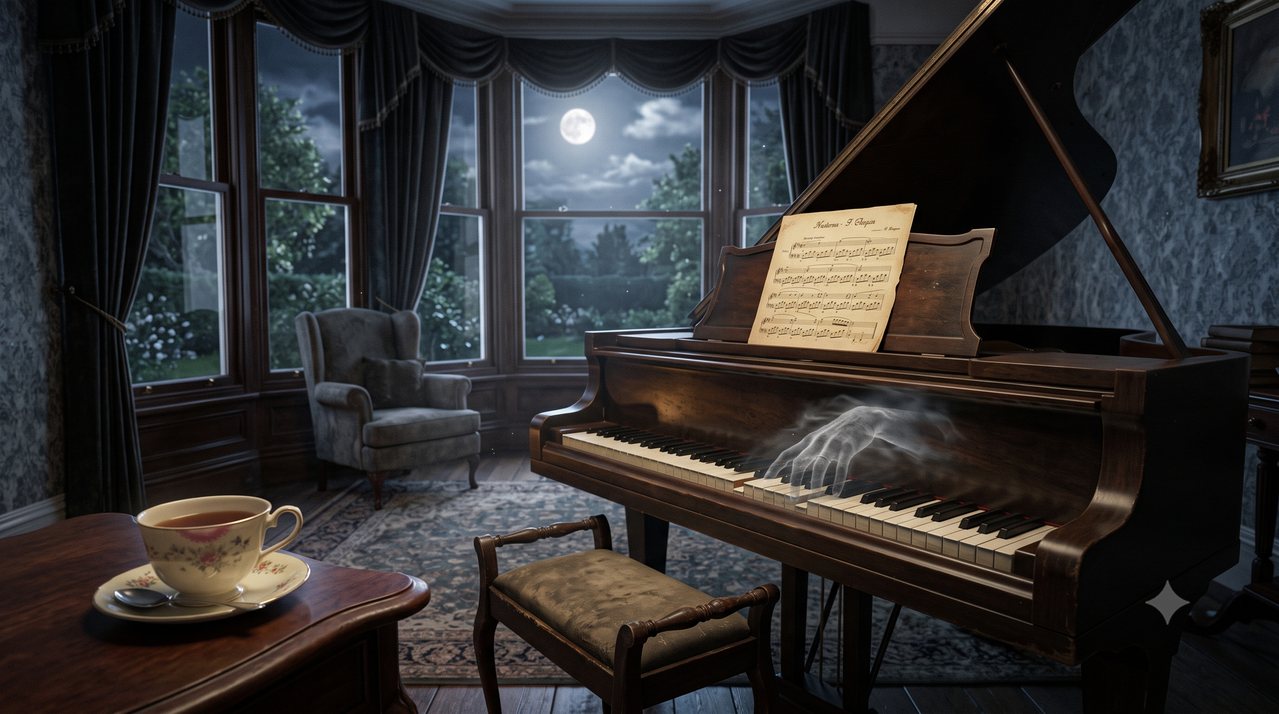
The parlour was the heart of the house. A Steinway grand piano stood in the bay window, hidden beneath a white dust sheet like a ghost at its own funeral. Alice did not remove the sheet. She walked past it, into the kitchen, and made herself a cup of tea that she didn't finish.
The first night, she heard the note.
A single key. Middle C. It came from the parlour at a little past two in the morning, soft but certain, as if someone had pressed it once and then lifted their finger. Alice lay in the unfamiliar dark of the guest bedroom, her heart knocking against her ribs. She told herself it was the house settling, the old strings contracting in the cold, a mouse on the soundboard. She did not go downstairs.
The second night, it was three notes. C, E, G—a quiet major chord, held for a long moment and then released. She sat up in bed. The parlour door was visible from the landing, and she could see a thin line of moonlight beneath it. The chord had not been a random sound. It had been an invitation.
In the morning, she lifted the dust sheet. The piano was immaculate, its black lacquer gleaming like still water. The keys were clean. The music stand held a single sheet of yellowed manuscript paper, handwritten in fading ink: Chopin's Nocturne in E-flat major, Op. 9, No. 2. At the top, in Eleanor's looping script, a dedication: For Alice, when you're ready. —Aunt E.
Alice's throat closed. She had been fourteen when Eleanor had given her that piece. She'd practiced it for months, fingers stumbling over the runs, and on the night of the recital she had frozen, hands hovering above the keys, the silence stretching until someone in the audience coughed and her mother led her from the stage. She had never played it again. She had never even opened the sheet music. And yet here it was, on the stand, as if it had been waiting.
She closed the fallboard and left the room. She told herself the music was a coincidence, a leftover from some forgotten lesson, a piece of sentimental clutter. But she knew—hadn't Eleanor's solicitor told her the house had been cleared before the sale? There should have been nothing on the piano at all.
That evening, she almost told her sister. They spoke on the phone, Katherine's voice warm and worried from two hundred miles away. "How's the house? Creepy yet?" she asked, and Alice managed a laugh. She wanted to say: Aunt Eleanor left me a piece of music I haven't seen in eighteen years, and the piano is playing by itself, and I think she's still here. Instead, she said, "It's just an old house. Lots of dust. I'll be fine." She hung up and sat in the dark kitchen, listening to the silence that was not quite silent.
The music grew bolder. On the fourth night, the piano played the opening bars of the nocturne—hesitant at first, as if someone were reading the notes by memory, and then smoothing into a fragile, imperfect melody. Alice stood at the parlour door with her hand on the knob. The playing stopped the moment she touched it. She pushed the door open. The room was empty. The piano lid was open, the keys still warm under her fingers. The scent of lavender was so strong she could taste it.
She began to find things. A fountain pen on the hall table, still wet with ink that spelled her name. A teacup on the kitchen counter, half-full, the porcelain rim marked with the faint pink crescent of lipstick—Eleanor's shade, a coral rose that Alice had seen in a hundred photographs. A pair of reading glasses left open on the arm of the sofa, lenses still fogged from breath. Small, deniable details that added up to something undeniable.
Alice stopped sleeping. She sat in the parlour each night with the lights off, waiting. At 2:14 a.m., the piano bench creaked. A depression appeared in the velvet cushion, the shape of a slight woman settling into place. The keys depressed one by one, and the nocturne began again—not halting this time, but full and rich and deeply sad, as if the player had been practicing for years in some silent, invisible room.
Alice spoke into the dark. "Aunt Eleanor?"
The music stopped. A long pause. Then the lowest key on the piano, the A-flat, sounded once—a single, resonant hum that vibrated through the floorboards and up into her chest. The scent of lavender deepened, and Alice felt, unmistakably, a hand rest on her shoulder. Cold and light, like the weight of a sparrow. She did not scream. She did not run. She closed her eyes, and the hand remained there for the space of five slow breaths, and then it was gone.
The next morning, the manuscript paper was gone from the music stand. In its place was a fresh sheet, the ink still damp: Play it for me. Please.
Alice sat at the piano for the first time in eighteen years. Her fingers remembered more than she expected—the opening chords, the first gentle run, the way the melody shifted from hope to sorrow and back again. She played badly. She played with shaking hands and blurred eyes and a heart that felt like it was cracking open. She played until the last note faded, and the room was quiet.
Nothing happened. No cold hand. No scent of lavender. She sat in the silence, and the silence was unbearable.
She played the piece again. Better this time. She played it every day for a week, in the afternoon light, as autumn leaves fell past the bay window. She played until the notes felt like her own, until the nocturne lived in her fingers the way it had lived in Eleanor's. And on the final evening, as she struck the last chord, she heard a voice—clear and warm and completely human—say, "There you are, darling. I knew you'd come back."
She turned. The parlour was empty, but the piano bench beside her was warm, and the teacup on the side table was full, steam curling into the cold air.
Alice left the house a week later. She did not sell it. She hired a caretaker and returned to her teaching studio in the city, and when her students asked her why she'd started playing again, she said only that she'd remembered a promise she'd made a long time ago.
The caretaker, a quiet man named Mr. Finch, has never reported anything unusual. But sometimes, when he locks up at dusk, he hears a piano playing softly from the parlour—a nocturne, he thinks, though he doesn't know the name. He's never seen anyone at the keys. He doesn't mind. He says the house feels less empty than it should.
And once, in the depths of winter, he found a fresh cup of tea on the kitchen counter, still hot, with the faint mark of coral lipstick on the rim. He drank it. It was, he told his wife that night, the best cup of tea he'd ever had.
Grief and guilt are complicated visitors. If you've lost someone and regret weighs heavy, please know that unfinished business can often be laid to rest with gentle, patient care—and sometimes, with professional help. You don't have to face the music alone.