
The Thirteenth Chime
The Thirteenth Chime
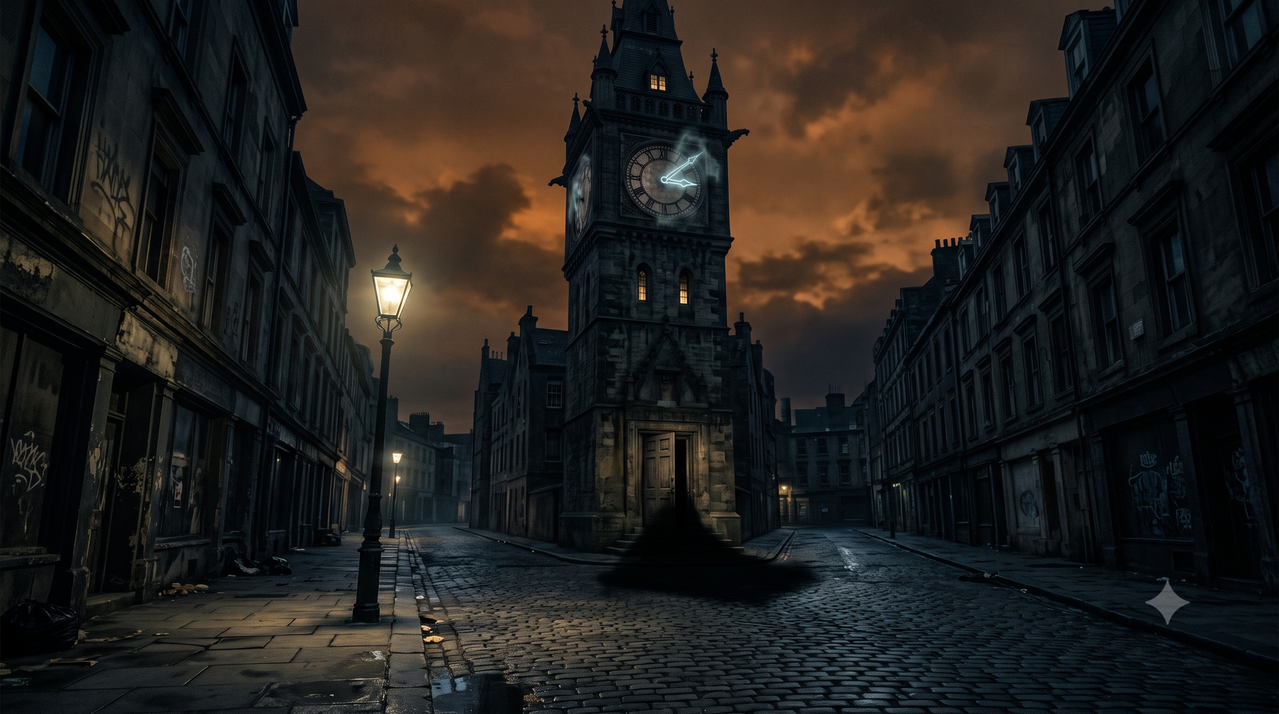
Every city has a clock tower. Ours is the old Meridian Municipal Building on Harlow Street, a granite giant with a spire that scratches the sky and a clock face that hasn't kept accurate time since 1974. The city stopped maintaining it decades ago. The hands are frozen at ten minutes past three. But the bell still rings. Every night, at exactly 3:13 a.m., it chimes thirteen times. Not twelve. Thirteen.
The legend started in the late eighties, back when the building was still in use. A night-shift custodian named Gerald Weeks was the first to notice. He'd be mopping the third-floor hallway when the first chime rang out, deep and resonant, vibrating through the marble floors. He counted them once on a dare with himself—twelve, thirteen—and then he heard something else. Footsteps. Heavy, deliberate footsteps descending the staircase from the clock tower, where no one was supposed to be. Gerald ran. He quit the next day. He told his wife, who told her sister, who told her bridge club, and the story spread like a stain.
Now, the legend goes like this: if you stand within earshot of the Meridian clock tower at 3:13 a.m. and count all thirteen chimes, you'll see the hands on the clock move. They'll spin backward, slowly at first, then faster, until they stop at 3:12. And then, from the spire, a fourteenth chime will ring—a sound that isn't a bell at all, but a human scream. After that, you have exactly sixty seconds to leave the shadow of the tower. If you don't, the footsteps will find you. They'll follow you home. They'll follow you forever.
My name is Sarah Teague, and I'm a reporter for the Meridian Chronicle. I cover city council meetings and pothole complaints. But two weeks ago, a body was found on the steps of the municipal building—a homeless man named Doug Rafferty, no signs of trauma, no drugs in his system, just dead with his eyes open and his mouth stretched wide as if he'd been screaming when his heart gave out. The coroner ruled it a cardiac event. The police closed the case. But Doug Rafferty had a piece of paper in his pocket with a single line of handwriting, shaky and cramped: I counted them all.
I started digging. I found Gerald Weeks's daughter, a woman in her sixties who remembered her father's story. "He never went near that building again," she told me. "Not even in daylight. He said the footsteps weren't human. He said they walked on the wrong beat, like someone was counting and getting it wrong on purpose." I found a retired security guard who'd worked the night shift in the nineties. He told me about a colleague who'd vanished for three days and reappeared on the tower steps, unable to speak, his hair turned white. "He never said what happened," the guard said, "but he'd flinch every time a bell rang. Even church bells. Even doorbells."
I told myself it was superstition. A shared delusion. A city's way of making sense of a creepy old building. But I'm a reporter, and a reporter needs proof. So three nights ago, I parked my car on Harlow Street at 3:00 a.m. and waited.
The street was empty. The clock tower loomed above me, black against the orange glow of the city sky. At 3:10, I got out of the car. At 3:12, I stood directly beneath the tower, my phone recording, my heart slamming. At 3:13 exactly, the first chime rang out. I counted. One. Two. Three. The sound was deeper than a bell should be, a low, mournful vibration that seemed to come from the ground as much as the air. Eight. Nine. Ten. The air grew cold. Twelve. Thirteen.
Silence.
I let out a breath I didn't know I'd been holding. The legend was nonsense. I looked up at the clock face. The hands were still frozen at 3:10. I laughed—a short, shaky sound—and turned to walk back to the car.
Then the clock hands moved. I saw it in my peripheral vision first, a slow, grinding motion. I turned back. The minute hand was crawling backward—ten past, nine past, eight past—sweeping toward the hour with a mechanical groan that hadn't been heard in that tower for fifty years. It stopped at 3:12. The second hand ticked once. The tower bell rang again.
A fourteenth chime. But it wasn't a chime. It was a scream—a human scream, high and ragged and cut short, as if someone had been thrown from the top of the spire. It echoed through the empty streets, and when it faded, I heard the footsteps. Heavy. Deliberate. Coming from the main door of the municipal building, which now stood slightly ajar, a dark mouth in the granite. The steps came toward me, and they were wrong—the rhythm was off, the spaces between footfalls too long, then too short, like a heart arrhythmia translated into motion.
I ran. I ran to my car, fumbled the keys, dropped them, grabbed them, and dove inside. The footsteps stopped at the edge of the sidewalk. I looked back. Nothing there. But the passenger seat of my car was suddenly cold, and the smell of old stone and dust filled the air. I drove home with the heat on full blast and didn't look in the rear-view mirror.
I've been home for three days. I haven't slept. Because every night at exactly 3:13 a.m., I hear a single chime from somewhere in my apartment—faint, distant, but unmistakable. And then footsteps. Not outside my door. Inside. In the hallway. Coming closer each night.
I'm writing this as a warning. If you live in Meridian, or any city with an old clock tower that doesn't keep time, don't go near it after midnight. Don't count the chimes. And if you hear a bell ring when no bell should be ringing, don't wait for the thirteenth chime. Don't even wait for the first.
Because the footsteps are already walking. They've been walking for decades, circling the tower, looking for someone who'll count all the way to the end. And once they find you, they don't stop. Not ever.
I can hear them now. They're right outside my bedroom door. The handle is turning. It's 3:14 a.m., and they're right on time.
Urban legends are thrilling because they let us explore fear from a safe distance. But if you find that fear has stopped feeling like a story and started feeling like something you can't shake, please reach out to a professional who can help you find your footing again. Reality is safer than it feels in the dark.
Metadata
- Title: The Thirteenth Chime
- Title Slug:
the-thirteenth-chime
Cover Image Prompt
A deserted city street at night, dominated by the silhouette of an old clock tower against a bruised orange sky. The clock's hands are frozen at 3:12, but a faint ghostly glow outlines them mid-motion, as if they are about to move. A single streetlamp pools light on the empty sidewalk, and the heavy wooden door of the tower is slightly ajar, with a shadow pooling out onto the steps—a shadow that doesn't match any visible object. Cold, urban, deeply unsettling. No gore.
Image Alt Text
A night-time city street with an old clock tower, its hands frozen at 3:12, the door slightly open and a shadow spilling out, evoking an urban legend about a deadly chime.
Tags
#UrbanLegend #CityHorror #ModernFolklore #ClockTower #GhostStories #PsychologicalHorror #ShortHorrorStory #TrueHorror #Warning
Excerpt
Every night at 3:13 a.m., the clock on the old municipal building strikes thirteen times. Count them all, and the hands will turn backward, the scream will sound, and the footsteps will follow you home. I'm a reporter. I didn't believe it. I counted. And now, three nights later, the footsteps are right outside my door.