
The Canary in the Shaft
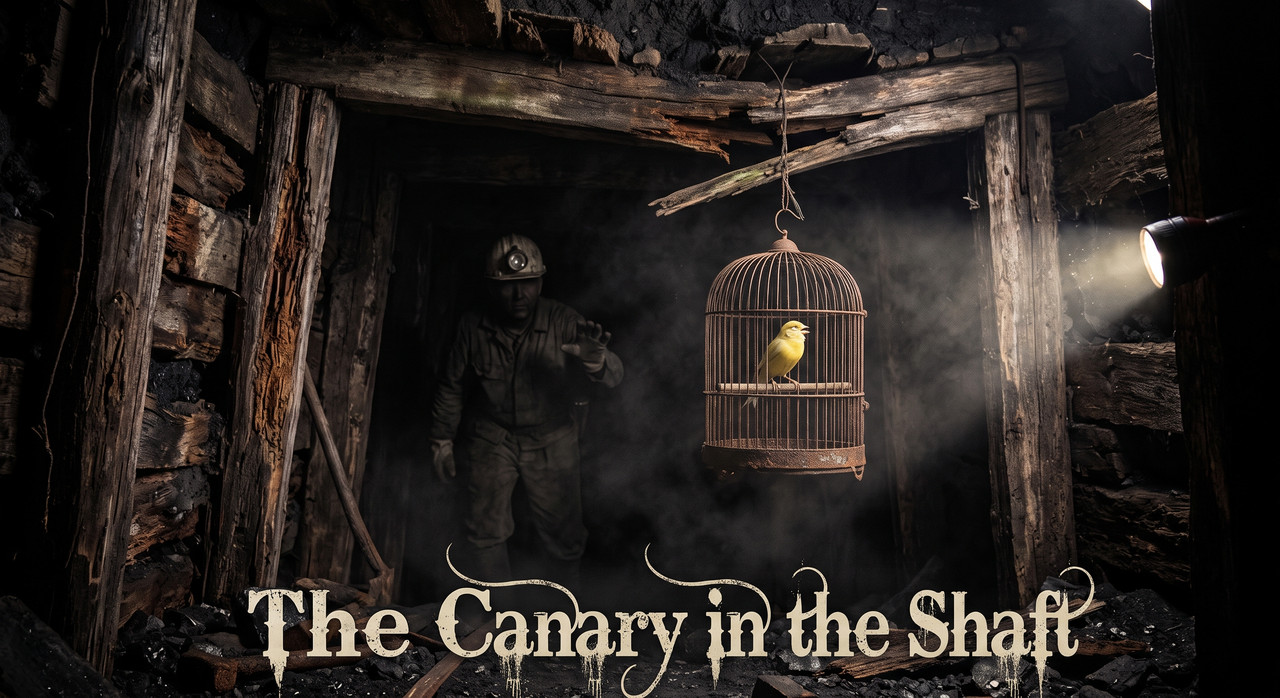
The Canary in the Shaft
A Paranormal Case File — Incident #2011-0722-WV
Date of Incident: July 15 – July 22, 2011
Location: The Bluebird Coal Mine (abandoned since 1968), near Gilmore, West Virginia
Lead Investigator: Dr. Elaine Voss, Paranormal Research Institute (PRI)
Status: Unexplained. 4 missing persons. Mine entrance collapsed and sealed. Entity classified as “The Singing Miner.” Active investigation.
1. Initial Report
On July 16, 2011, the Gilmore County Sheriff’s Office received a 911 call from a terrified young woman, Sarah Whitfield, 21, who claimed that she and three friends had entered the abandoned Bluebird Coal Mine the previous evening as part of an urban exploration trip. The mine, which had been sealed by federal order since the 1968 Bluebird Disaster, was supposed to be impenetrable, but a recent landslide had exposed a narrow opening in the hillside. The group crawled inside.
For the first hour, the group explored the outer galleries, filming with a handheld camera. Then, at precisely 2:13 a.m., they heard it: a distant, echoing whistle—three notes, descending, like a bird’s call, but wrong, distorted, as if played on a broken flute. It came from deep within the mine. Then they heard the singing. A man’s voice, low and rough, singing a folk song from the 1930s: “I’m a miner’s son, and the coal is black, and the company store won’t call me back…” The voice echoed through the tunnels, directionless, fading in and out.
Jake Morrison, 23, the most skeptical of the group, insisted on finding the source. He walked toward the sound. The others followed. The singing grew louder, then stopped. In the beam of their flashlights, they saw a canary cage hanging from a wooden beam. The cage was rusted, but the door was open, and inside, sitting motionless, was a small yellow bird. It was alive—or appeared to be—though its eyes were pure white, like marble. It opened its beak and let out that same three-note whistle, impossibly loud for such a small creature.
Sarah turned to leave. The tunnel behind them was gone. In its place, a wall of solid rock. The group was trapped.
Sarah alone escaped, she doesn't know how. She woke up outside the mine entrance at dawn, her hands bleeding, her memory of the night fragmented. The other three—Jake Morrison, 23; Emily Hart, 20; and Marcus Webb, 24—were never seen again.
The responding officer, Deputy Rachel Cole, noted that the mine entrance was collapsed, freshly sealed, and that a single bird’s feather lay on the ground outside. It was yellow, and when she picked it up, it turned to dust in her fingers, leaving a black smear. PRI was contacted on July 18 after Sarah’s parents reported that their daughter had begun whistling the same three notes in her sleep, and that a small yellow bird had appeared outside her window every morning, staring in.
(Source: Gilmore County Sheriff’s Incident Report #2011-0716-BCM-228, Deputy R. Cole; witness statement, Sarah Whitfield, PRI Appendix A; recovered feather, forensic analysis, PRI Appendix B.)
2. The Disappearances
PRI reconstructed the events based on Sarah’s fragmented testimony, a partial video recording recovered from the mine entrance, and interviews with local residents.
- July 15, 10:40 p.m.: Sarah Whitfield, Jake Morrison, Emily Hart, and Marcus Webb enter the Bluebird Coal Mine through a landslide-opened fissure. Their initial footage shows them laughing, the walls of the old mine dripping with moisture, the air thick with coal dust.
- July 16, 2:13 a.m.: The group hears the whistle and the singing. The video feed becomes unstable, showing only brief flashes: a canary cage, a figure in a miner’s helmet, a wall of rock that shouldn’t be there. The last frame shows Jake Morrison reaching toward the canary, his face pale and empty, his eyes reflecting an impossible yellow light.
- July 16, 5:30 a.m.: Sarah is found wandering near the entrance, covered in black dust and crying. She is hospitalized. The other three have vanished.
- July 17: Search teams enter the mine through an alternative air shaft. They find the group’s backpacks, a flashlight still on, and a video camera. The camera’s footage shows the group being led deeper into the mine by an unseen presence, their movements stiff, their eyes glazed, like sleepwalkers. The final clip is a close-up of a canary, its beak opening and closing, its white eyes filling the screen. A voice whispers: “The canary sings, and the miner listens. Now you are the canary.”
- July 18: A fifth person, a local historian named Dr. Elias Crane, 58, ventures into the mine to investigate. He does not return. His notebook is later found near the collapsed entrance, open to a page with a single sentence scrawled in black ink: “The canary is not a bird. It is a warning of what we buried.”
(Source: Search and rescue logs, Gilmore County; recovered video camera, forensic analysis, PRI Appendix C; Dr. Crane’s notebook, PRI Appendix D.)
3. The Evidence
- The Canary Cage: Recovered from the mine’s outer gallery. It is a standard 1930s mining canary cage, rusted but intact. The door is open, and inside is a single yellow feather, still fresh. The cage is cold to the touch and emits a faint, rhythmic humming at 15 Hz. When placed near any bird, the bird becomes agitated and begins singing the same three-note whistle, then falls into a catatonic state. The cage is stored in a soundproofed container at PRI’s West Virginia facility.
- The Video Camera: 47 minutes of footage. Dr. Samir Patel’s analysis confirms the footage is unmanipulated. The images of the canary and the miner are authentic, though the miner’s face is always obscured by the helmet’s shadow. The audio contains the singing voice, and Dr. Hannah Lim’s spectrographic analysis reveals that the voice is composed of layers: a man’s voice, a child’s voice, and the chirping of a canary, all synchronized. The final whisper, “Now you are the canary,” is repeated in reverse, a classic technique in certain Appalachian folk curses.
- The Feather: The yellow feather recovered by Deputy Cole turned to dust but left a black smear that tested positive for coal dust and a compound similar to cantharidin, a blistering agent. The smear also contained traces of human DNA from an unknown donor, indicating the feather was not from a real bird but was a manifestation.
- The Miner’s Helmet: Found by a PRI team deep in the mine. It is an authentic 1930s carbide lamp helmet, still functional. When activated, the lamp’s flame burns a bright, unnatural yellow, and shadows cast by the light move on their own, forming the shape of a tall, thin man. The helmet is stored in a light-tight vault.
(Source: PRI Forensic Reports, July-August 2011; Materials analysis, West Virginia University; Audio forensics, PRI Appendix E.)
4. Historical Research
Dr. Peter Chand and local historian Dr. Elias Crane (now missing) researched the Bluebird Coal Mine’s dark past.
The Bluebird Mine opened in 1928, owned by the Gilmore Coal Company. It was known for its dangerous conditions, and miners whispered of a “singing man” who appeared before each disaster, whistling a three-note warning. On December 17, 1931, a gas explosion killed 34 miners. Rescuers who entered the mine reported hearing a man singing from deep within the wreckage, a song about a miner’s son, though no survivors were found. The mine was closed but reopened during World War II.
In 1968, a second disaster occurred: a roof collapse trapped 12 miners. Again, the singing was heard, and a canary, somehow alive, was found in a cage near the collapse site, its eyes white, its beak moving as if singing. The mine was sealed permanently by federal order.
Dr. Crane’s research (before his disappearance) uncovered a darker story: in 1931, the mine’s owner, a man named Silas Vane, had brought a young boy into the mine to act as a “human canary,” believing the child’s soul could detect gas before it ignited. The boy died in the explosion, and his body was never recovered. The singing man is believed to be the boy’s spirit, now fused with the canary and the mine itself, luring others to share his fate.
(Source: Gilmore County Historical Society, “The Bluebird Mine Disasters,” 1968; Vane, S., personal ledgers, 1928-1931, Gilmore County Archives; Dr. Crane’s preliminary notes, PRI Appendix F.)
5. Preliminary Analysis
Dr. Voss’s assessment:
-
Entity Classification: The Singing Miner is a Class-Ω Compound Revenant—a fusion of a child’s spirit, a canary, and the collective fear of the miners who died in the Bluebird Mine. It is not a single ghost but a manifestation of the mine’s trauma, using the bird’s call and the miner’s song to lure victims into the depths.
-
Modus Operandi: The entity activates at 2:13 a.m., the time of the 1931 explosion. It lures explorers with the three-note whistle and the singing voice, creating a psychic pull that compels victims to follow. The appearance of the canary with white eyes is a trigger; those who look into its eyes become “marked,” losing their will and wandering deeper into the mine, where they are absorbed into the entity’s chorus. The missing persons are likely alive, trapped in a dark, soundless space, their voices now part of the song.
-
The Canary as a Psychopomp: The canary is the entity’s core. It serves as both lure and warning, a remnant of the boy’s soul. The feather that turned to dust and the cage that drives birds mad are evidence of its power.
-
Risk Assessment: Extreme but contained. The mine entrance has collapsed, sealing the entity. However, the three-note whistle has been reported in the nearby town during quiet nights, and a local child has begun drawing pictures of a yellow bird with white eyes. The entity’s influence is spreading through dreams and sounds.
-
Containment: The cage and helmet are stored in separate vaults. The mine is sealed. PRI has issued a covert warning through local churches and schools, framed as a “safety alert.” Further investigation is scheduled, but the risk of reopening the mine is too great.
6. Postscript and Current Status
As of August 2011, the three missing explorers and Dr. Elias Crane remain missing. Sarah Whitfield has been placed in psychiatric care; she speaks in a low, masculine voice and sings the miner’s song when she sleeps. A canary has been seen outside her window each morning, its eyes white, its beak open in that same impossible whistle.
The Bluebird Mine remains sealed. At night, a faint singing can be heard from the hillside, and the ground shakes as if something is moving below. A local pastor attempted an exorcism; he emerged from the mine entrance babbling about “the boy who waits in the dark,” and has not spoken since.
A fifth person, a journalist named Alicia Ford, has been documenting the case for a national magazine. She reports that her tape recorder sometimes picks up the three-note whistle, and that her reflection in the mirror occasionally shows a yellow bird perched on her shoulder, even though no bird is there.
If you hear a three-note whistle from an abandoned mine, do not follow it. Do not look at the canary. And if you hear the miner’s song, run. The canary has already sung for you.
This story deals with themes of industrial tragedy, child labor, and the horror of being forgotten. If you experience auditory hallucinations or disturbing dreams, please reach out to a mental health professional. You are not alone, and the singing is not real.