
The Chair by the Window
The Chair by the Window
The first time Frank heard the rocking chair, he blamed the wind. October had turned the farmhouse into a box of groans—floorboards contracting, window frames trembling under gusts that smelled of stripped cornfields. He lay in the bed he’d shared with Margaret for forty-one years, listening. The sound came from the living room. A soft, rhythmic creak. Rock. Pause. Rock.
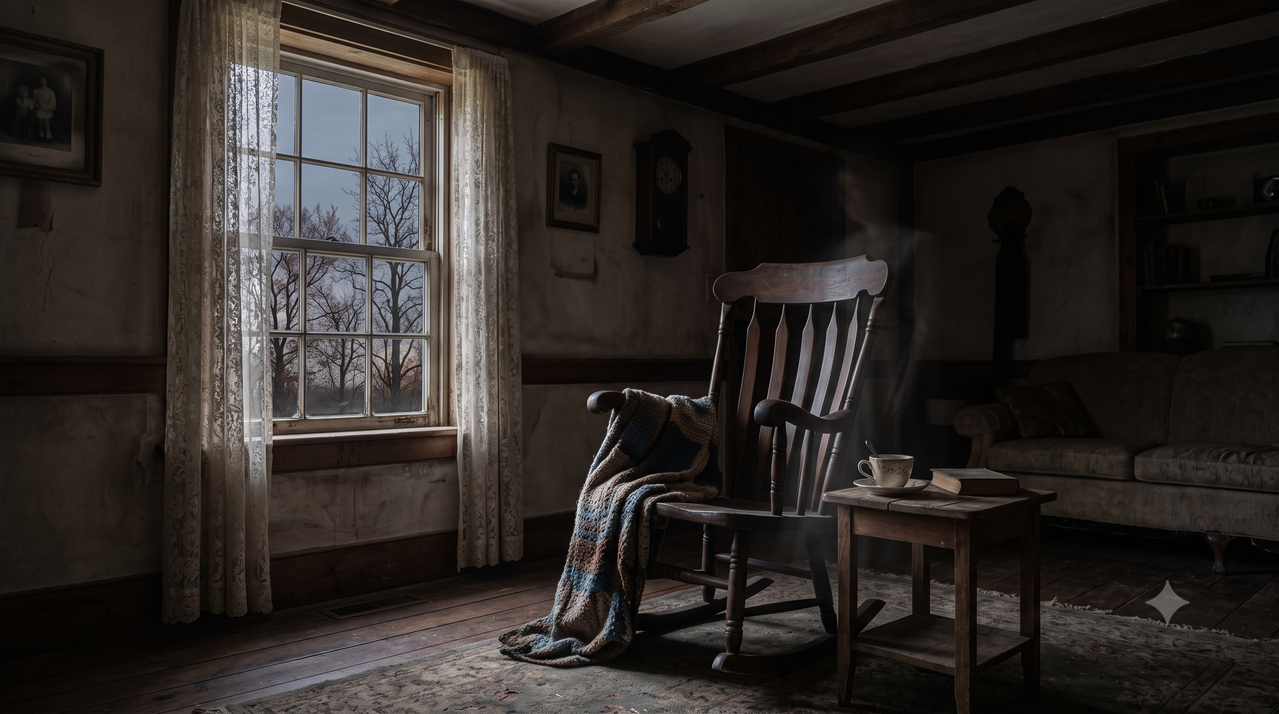
He did not get up. He pulled the quilt to his chin and stared at the ceiling until the sound stopped. In the morning, the chair sat exactly where it always had: angled toward the east window, a faded afghan draped over one arm, Margaret’s sewing basket beside it. Empty.
The second night, he made a bargain. If the chair creaked again, he would go see. At ten past two, the sound returned—a dry whisper of wood on wood, three creaks, then nothing. He sat up, heart pressing against his ribs. He thought of the shotgun in the hall closet. He thought of Margaret’s laugh, the way she’d reach across the table to straighten his collar without being asked. He stayed in bed.
By the fourth night, the creaking had grown bolder. It would start the moment the house settled into true dark, a steady to-and-fro that could have been someone sitting and thinking, toe pushing gently against the floor. Frank began to notice details he’d previously ignored: the afghan that had shifted two inches since supper, the faint depression in the chair cushion that held the shape of a small woman’s hip. Once, he caught a smell—lavender sachet and something beneath it, the medicinal sharpness of the hospital.
He told no one. His daughter Sarah called every Sunday evening, her voice bright and careful. “How are you sleeping, Dad? Are you eating?” He’d watch the chair through the living room doorway while he talked, phone cord stretching into the kitchen, and say, “Fine. Soup and a sandwich. Don’t worry about me.” The words felt like pushing a heavy door shut.
Sarah lived in Des Moines with two kids and a husband who mowed the lawn on Saturdays. She’d come out twice since the funeral, both times with a casserole and a look on her face that said she was cataloging hazards—the loose porch step, the pile of unopened mail, the way Frank let the evening dishes sit until morning. “You know you could sell this place,” she’d said last visit, wiping a countertop that didn’t need wiping. “It’s too much house for one person.”
Frank had nodded, not because he agreed but because disagreement would require an energy he didn’t have. The truth was he couldn’t imagine leaving. He and Margaret had bought this farm in 1979, six acres of good soil and a house with a wraparound porch that caught the sunset like a held breath. She’d planted the marigolds every spring. She’d rocked their daughter in that chair. She’d rocked herself in it through the long months of the illness, a book open in her lap that she never read, eyes fixed on something just beyond the glass.
That was the part Frank couldn’t let himself think about directly: those months. He’d been a good husband in all the measurable ways—paid the bills, fixed what broke, drove her to appointments. But he’d learned, too late, that there was a difference between doing and being. When the pain kept her awake, he’d slept in the guest room because he had to be sharp for work. When she’d start a sentence and trail off, he’d fill the silence with talk about the weather, the soybeans, the county fair. He hadn’t known how to sit with her quiet. He hadn’t tried.
Now the quiet was all he had, and the chair was filling it.
A week passed. Frank developed rituals. Each morning he straightened the afghan, fluffed the cushion, aligned the sewing basket so its handle pointed north. Each night he locked the living room door before bed. It was an old door with a crystal knob and a keyhole that took a skeleton key he kept on a nail in the pantry. Locking it made him feel like a man taking sensible precautions. The chair creaked anyway.
He began to notice other things. The television would be on when he came in from the barn—not a channel he’d chosen, something old and black-and-white with flickering couples who spoke in cigarette smoke. A glass of water on the end table would be half-empty, though he’d filled it fresh that morning. Once, he found a silver hair on the chair back, long and fine, and he held it to the light until his hand shook, then tucked it into his shirt pocket like a secret.
He almost told Bob Pearson, his nearest neighbor, a man who farmed soybeans and minded his own business. They met at the fence line one afternoon, two old men resting their arms on weathered posts. “You ever feel like a place remembers people?” Frank asked, looking past Bob toward the house. Bob chewed a stem of grass. “You mean like ghosts?” he said, and laughed, a short bark. Frank forced a smile. “Forget it. Just talking.” Bob shrugged and said something about the price of corn, and Frank nodded and let the moment close. He couldn’t bear the thought of Bob’s polite concern, the careful way people talked to a recent widower, as if grief were a broken leg you’d eventually walk off.
That evening, Sarah called. “Dad, I’ve been thinking. Maybe I could come stay with you for a week. The kids would love the farm. We could—”
“No,” Frank said, too quickly. “Not yet. I’m still sorting through her things. It’s a mess.” He lied easily now. The lie was a wall and he was getting good at building it. “Okay,” Sarah said, her voice smaller. “Just… you’d tell me if something was wrong, right?” Frank looked through the doorway at the chair, motionless in the lamplight, and said, “Of course I would. Nothing’s wrong.”
That night the creaking started earlier. Ten o’clock. Frank was still in the kitchen, hand wrapped around a cold cup of coffee, when he heard it: rock, pause, rock. Steady and patient, like someone waiting for him to come in. He set the cup down and walked to the living room door. The crystal knob was cold under his palm. He didn’t open it. He pressed his forehead to the wood instead, listening. The creaks continued—rhythmic, almost meditative. And then they stopped.
In the sudden silence, Frank heard something else. A breath. Not his own. A soft exhale from the other side of the door, so close he felt the air shift against the gap beneath it. He stumbled back, heart pounding, and stood in the dark kitchen until the grandfather clock struck eleven. He slept on the sofa in the den that night, the shotgun across his knees, though he knew he would never fire it at a ghost, and he wasn’t sure what it meant that he’d admitted, even to himself, that’s what she was.
November came with hard frosts and a sky the color of old pewter. Frank stopped locking the living room door. Instead he began sitting in the chair. Not at night—not yet—but in the afternoons, when the sun cut through the east window and warmed the upholstery. He’d lower himself into it carefully, as if someone might be there, and close his eyes. The chair didn’t creak when he sat in it. It held perfectly still, like a held breath.
He found himself talking to her. Small things at first. “The tractor’s acting up. Remember how you used to bang on the hood until it started?” Then larger things. “I should’ve sat with you more. I should’ve let you finish your sentences.” The words came out raw and unpolished. He didn’t expect an answer, and he didn’t get one—not in words. But one afternoon, as he sat with his eyes closed, he felt a weight settle onto the arm of the chair. Light, delicate, like a hand resting just beside his own. He didn’t open his eyes. He didn’t move. The weight stayed for perhaps a minute, then lifted. When he finally looked, the afghan was warm on that side, and the smell of lavender hung in the air so strongly he almost wept.
That was the day he understood something terrifying: he didn’t want it to stop. The haunting—he could finally use that word—had become the only thing tethering him to her. Without it, there was just the empty house, the silent phone, the fields going gray under winter. His guilt had found a shape, and that shape was the chair, and if he lost it he’d have to face the guilt alone. He wasn’t ready.
He started leaving things for her. A cup of the chamomile tea she’d loved, placed on the end table before bed. In the morning it would be cold, but the level would be lower. He’d pour it out and make a fresh one, and the routine felt holy.
Sarah came for Thanksgiving. She arrived with a turkey in a cooler and her youngest, a six-year-old named Lily who ran through the house like a windstorm. Frank braced himself. He’d tidied the living room obsessively, pushed the chair back against the wall, removed the sewing basket entirely. He told himself the house would behave, as if it were a dog he’d trained.
The visit started well. They ate early, turkey and stuffing and the cranberry sauce from a can that Lily insisted tasted like jam. Frank felt almost normal, passing the gravy, laughing at Lily’s stories. But when the dishes were cleared and Sarah settled the child on the sofa with a tablet, she turned to him with that look—the cataloging one.
“Dad, I found something,” she said. She pulled a small spiral notebook from her bag, the kind Margaret used for grocery lists. Frank recognized the handwriting instantly: her round, careful letters, the loops on her g’s that swept a little too far. “It was in the sewing basket,” Sarah said. “I wasn’t snooping, I just… I wanted a needle to fix Lily’s coat.”
Frank’s throat closed. He hadn’t looked inside the sewing basket. He’d moved it but never opened it.
“It’s from the last few weeks,” Sarah continued, her voice tight. “Listen. ‘Frank won’t look at me when I talk about the pain. He fixes the porch light instead. He thinks I don’t notice.’” She turned a page. “‘Today I asked him to just sit with me. He said he had to check the south field. The field doesn’t need checking.’”
Frank stared at the notebook as if it were a live thing. He could hear Margaret’s voice in those words, the quiet disappointment, the loneliness she’d carried while he busied himself with unimportant tasks.
“Dad,” Sarah said, and now her eyes were wet, “did you know she felt this way?”
He wanted to tell her everything—the creaking, the breath under the door, the hand that rested beside his, the impossible weight of all the words he’d never said and was only now learning to say to an empty room. He opened his mouth. He looked past Sarah’s shoulder to the living room doorway, where the east window caught the last of the November light, and for one dizzying moment he thought he saw the chair rock—just a little, just once—as if someone were listening.
“No,” he said. “I didn’t know.”
Sarah closed the notebook. “She loved you, Dad. I know she did. But I think… I think she was lonely.” She said it gently, without blame, but Frank felt it anyway. He nodded, unable to speak, and Sarah reached across the table to squeeze his hand. Lily, oblivious, giggled at her tablet.
That night, after Sarah had tucked Lily into the spare room and gone to bed herself, Frank sat in the living room in the dark. He didn’t turn on a lamp. He lowered himself into the chair—Margaret’s chair—and waited. The cold glass of the window pressed the night against his skin. He expected the creak to start, the breath, the hand.
Instead, the room stayed absolutely still. The house held its silence like a wound that had finally scabbed over. He realized, sitting there, that she’d given him what he’d asked for: a chance to apologize, a presence that didn’t leave even when he failed. And now that he’d heard her real voice—the one in the notebook, the one he’d ignored for months—the haunting had eased. Not vanished, but softened. The guilt was his to carry alone now. That was the price of not listening when she was alive.
He stayed in the chair until dawn grayed the window, and when he finally rose, his joints aching, he knew he’d never hear the creaking again. Not in this house. But he also knew that lonely things don’t simply disappear. They find new vessels.
Sarah and Lily left the next day. Frank walked them to the car, hugged his daughter a little longer than usual, and watched the station wagon crunch down the gravel drive until it vanished behind the windbreak of poplars. He went inside and sat on the sofa, not the chair, and let the silence settle.
Three days later, Sarah called. Her voice was strange—not worried exactly, but confused. “Dad, something weird happened. Last night, Lily woke me up around two in the morning. She said she heard her rocking chair moving. The little one in the corner of her room. And she said it smelled like flowers, the way Grandma’s house used to. What do you make of that?”
Frank closed his eyes. Outside, the first snow of the year began to fall, quiet and soft, covering the fields in white.
“Nothing to worry about,” he said. “It’s just an old house settling.”
But he knew. Some loneliness is a seed. Some chairs don’t stop rocking. They just find someone else to sit in them.
If the themes of grief and isolation in this story resonate with you, please know you’re not alone. Reaching out to a friend, family member, or mental health professional can make a real difference. Support is worth seeking, and you deserve it.