The Coin Slot That Hungers
The Coin Slot That Hungers
A Paranormal Case File — Incident #2024-0713-OR
Date of Incident: July 13 – July 19, 2024
Location: PixelCon Retro Gaming Expo, Portland, Oregon; linked to a private storage unit in Salem, Oregon
Lead Investigator: Dr. Elaine Voss, Paranormal Research Institute (PRI)
Status: Unexplained. Cursed arcade cabinet contained. Four missing persons. One fatality. Digital footprint ongoing. Machine stored in PRI Vault 7.
1. Initial Report
On July 14, 2024, the Portland Police Bureau received a missing‑person report from the organizer of PixelCon, a large retro‑gaming convention held at the Oregon Convention Center. The missing individual was Liam Park, 24, a popular Twitch streamer known as “TokenTerror.” Park had been scheduled to host a live “mystery unboxing” event on the final night of the con, July 13. He did not appear for his checkout on July 14, and his hotel room was found empty. His streaming equipment was still set up at the convention center, but his laptop was missing, and his hotel room contained only a single, tarnished silver arcade token on the nightstand.
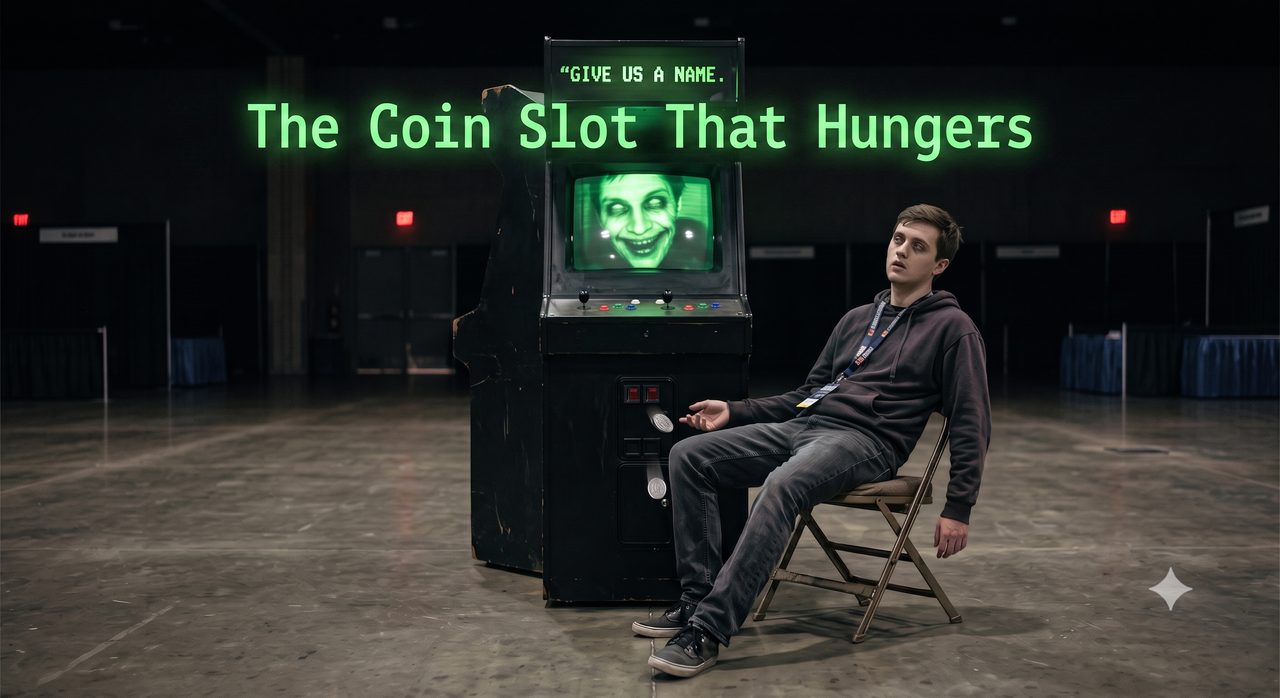
Convention staff reported that Park had spent the previous evening alone in a private booth, live‑streaming himself playing an unmarked arcade cabinet that a vendor had brought from a storage unit in Salem. The cabinet, a heavy black pedestal with a single coin slot, a glowing green CRT, and no marquee, had been sold to the vendor sight‑unseen. The vendor, an antique collector named Gerald Hwang, told police that the cabinet had been stored in a sealed unit since 1983 and that the previous owner, a deceased game designer named Reginald Crowe, had left a handwritten note inside the coin box: “It plays you back. Never let it count to 9.”
The PPB examined the cabinet at the convention center early on July 14. The screen was still on, displaying a flickering title card: “ABYSSUS — INSERT COIN TO BEGIN.” The high‑score list showed a single entry: “Liam — 888.” The score pulsed faintly, as if alive. Officer Rachel Chu noted in her report that the machine emitted a low hum that caused her to feel “intensely watched.” When she touched the joystick, the screen flashed white, and the high score changed to “Rachel — 1.” She withdrew immediately. The cabinet was quarantined, and PRI was contacted after Officer Chu began experiencing vivid nightmares of falling through an endless, starless void, her screams swallowed by silence.
(Source: PPB Incident Report #2024-0714-CC, Officer R. Chu; PixelCon vendor registry; Gerald Hwang statement, PRI Appendix A.)
2. The Stream
PRI obtained a copy of Liam Park’s stream VOD from his Twitch channel before it was taken down by the platform. The footage, 47 minutes long, captures Park in his booth, enthusiastically unboxing the black cabinet for his viewers. He reads aloud the note from Reginald Crowe and laughs. “Creepy backstory, right? Let’s see if this old thing even powers on.”
The game is simple, a vector‑graphics descent through a series of concentric squares, each level a smaller ring, with cryptic symbols on each side. The goal appears to be navigating a glowing dot to the center while avoiding jagged, shifting shapes. Park plays casually, commenting on the crude graphics. Then he reaches Level 9.
At Level 9, the game pauses. The symbols on the screen rearrange themselves into a single, coherent message: “YOU HAVE REACHED THE THRESHOLD. GIVE US A NAME.” Park laughs nervously. “Creepy pasta stuff, guys.” He types his stream handle into the game’s text prompt. The screen glitches violently, and a sound like a coin dropping into a slot echoes from the cabinet’s speakers. Park screams. The camera shakes. When it refocuses, Park is slumped in his chair, eyes open but glassy, and the screen displays the high‑score list: “Liam — 888.” The stream ends there, but the VOD continues recording audio for another 12 minutes: a low, rhythmic dripping, occasional wet clicks, and a voice whispering, “Insert another. The game is hungry.”
(Source: Twitch VOD, “TokenTerror Unboxes MYSTERY CABINET @ PixelCon!” July 13, 2024; Forensic analysis by Dr. Samir Patel, PRI Appendix B.)
3. The Chain of Disappearances
PRI reconstructed the cabinet’s path through convention attendees.
- July 13, 10:30 p.m.: A convention security guard, Darnell Reaves, 39, noticed the cabinet had been left on after Park’s disappearance. He approached it, inserted a stray token he found on the floor, and played for 4 minutes. His body was found the next morning in a locked maintenance closet, 200 yards from the booth. He had suffered a cardiac arrest, but his face was frozen in an ecstatic grin, and his right hand was clenched around a silver token identical to the one found in Park’s hotel room. His high score on the machine read “Darnell — 47.”
- July 14: A curious attendee, a 17‑year‑old named Emily Song, avoided the cabinet but took a photo of the screen with her phone. That night, she told her parents that she could hear a coin dropping in her bedroom. She went missing from a locked bathroom; her phone was found inside, the photo album filled with hundreds of images of the Level 9 screen, each one slightly zoomed in, as if the symbols were moving closer.
- July 15: Gerald Hwang, the vendor, attempted to smash the cabinet with a sledgehammer after learning of the deaths. The hammer bounced off the wood, and Hwang was thrown backward by an unseen force. He suffered a broken arm and claimed the machine “screamed” at him. He has since refused to discuss the incident.
- July 17: A YouTuber who had downloaded and mirrored Park’s VOD reported that the video file on his hard drive spontaneously re‑encoded itself into an interactive game file that, when opened, displayed the Level 9 prompt. He did not enter a name. The file deleted itself. However, his home’s smart speaker began playing the sound of a coin dropping every 3:03 a.m.
A total of four individuals—Park, Reaves, Song, and a security guard from the convention center who had assisted in moving the cabinet—are now missing or dead. The common link is direct interaction with the cabinet or its digital footprint.
(Source: PPB missing‑person reports, July 14‑19, 2024; PRI witness interviews, Appendix C.)
4. The Evidence
- The Arcade Cabinet: The machine is a custom‑built pedestal cabinet, manufactured in 1983. No manufacturer’s plate exists. The hardware is a modified Z80 processor, but the PCB contains a secondary board etched with intricate, non‑functional circuits that form the same symbols seen on Level 9. The coin slot mechanism has been altered: instead of registering a simple contact closure, it activates a photoresistor that measures the reflectivity of the inserted token. The silver tokens found at the scenes are made of an alloy containing 12% human bone ash. PRI metallurgists have identified the ash as belonging to at least nine different individuals, all of whom died between 1980 and 1983. The cabinet’s ROM, when dumped, is exactly 666 kilobytes, and analysis shows it contains a secondary program that activates only after Level 9, a program that is not a game but a communication protocol.
- The Silver Tokens: Each token weighs 8 grams. Under magnification, the tokens are etched with the same Level 9 symbols, spiraling into the center. Touching a token with bare skin induces immediate feelings of vertigo and a compulsion to “insert” it into something—a vending machine, a parking meter, a coin slot. Two PRI researchers who handled the tokens reported hearing a distant voice counting backward from 9.
- Audio Analysis (Dr. Hannah Lim): The audio from Park’s VOD and from Reaves’s body camera contains a 19 Hz infrasound component, modulated to mimic a human heartbeat at 33 bpm—the average heart rate of a person in a state of extreme terror. Beneath that, a sub‑audible loop of nine voices, each speaking a different name, followed by the phrase, “The ninth is the door.”
- Digital Propagation: The VOD file and any screenshots taken of the Level 9 screen act as vectors. The Level 9 symbols, when processed by a device’s display driver, can rewrite the device’s boot sector to display the prompt, “GIVE US A NAME,” upon startup. Several infected devices have been recovered and isolated in a Faraday cage. They continue to function without power and will display the prompt if any reflective surface is placed in front of their cameras.
(Source: PRI Forensic Reports, July‑August 2024; Metallurgy analysis, Oregon State University; Digital forensics, PRI Appendix D.)
5. Historical Research: Reginald Crowe and the ‘Osiris Game’
Dr. Peter Chand traced the cabinet’s designer, Reginald Crowe, a former Atari engineer fired in 1982 for “unspecified ethical violations.” Crowe was known to be obsessed with ancient Egyptian funerary rituals and the concept of the soul being weighed against a feather. In late 1982, he joined a small arcade startup called Threshold Interactive, which produced only one prototype: a game tentatively titled “Osiris,” intended to “bridge the gap between the living and the dead using coin‑operated technology.” Company records, found in a storage unit in Salem, show that Crowe had convinced the investors that the game’s coin mechanism would serve as a “psychopomp interface,” allowing players to commune with deceased loved ones. In reality, the Level 9 ritual was designed to offer the player’s soul to an entity Crowe called “The Auditor,” in exchange for a “high score”—a measure of remaining life force.
Crowe died in 1983, ostensibly of a heart attack, but his body was found inside the cabinet prototype, folded into the coin box, his own silver token clutched in his hand. The unit was sealed in storage and forgotten until the unit’s 2024 auction. Crowe’s journal, recovered by PRI, contains the repeated phrase: “The ninth coin opens the mouth. Never count to nine. The game is never over.”
(Source: Threshold Interactive corporate records, 1983; Crowe, R., personal journal, Salem Storage Auctions, 2024; Oregon Death Records, 1983.)
6. Preliminary Analysis
Dr. Voss’s assessment:
-
Entity Classification: The phenomenon is a Class‑Ω Token‑based Psychopomp Entity. The arcade cabinet functions as a ritual gate, with each inserted token representing a soul offered. The entity, “The Auditor,” is a non‑corporeal intelligence that feeds on the life force of players, trapping their consciousness within the game’s high‑score list. The missing individuals are not dead in the traditional sense; their minds are integrated into the game’s code, repeating their playthroughs eternally.
-
The Number Nine: The emphasis on the number nine is critical. In Egyptian mythology, the Ennead was a group of nine deities who judged the dead. The cabinet requires nine souls to complete a full cycle, after which it can “open” a permanent door. Currently, four souls have been consumed. If nine are ever fed, the entity may be able to manifest physically and expand its influence beyond the machine.
-
Digital Infection: The symbols act as a memetic hazard. Any device that displays them becomes a secondary coin slot, capable of accepting a “name” input. The prompt (“GIVE US A NAME”) is the ritual trigger. Once entered, the victim’s consciousness is transferred to the cabinet, regardless of physical proximity.
-
Risk Assessment: Extremely high. The cabinet has been moved to PRI Vault 7, contained within a room lined with lead, copper, and soundproofing. No reflective surfaces are permitted. All infected devices have been isolated. However, the VOD and images may still exist on private servers and phones. PRI has been working with social media companies to remove the footage, but the meme is out. A public advisory has been issued under the guise of a “dangerous hoax.”
-
Further Actions: PRI must locate and destroy any remaining silver tokens. Nine tokens are believed to exist, one for each soul. Currently, seven tokens have been recovered. The cabinet must never be powered on again and must be stored in complete darkness.
7. Postscript and Current Status
As of August 2024, the arcade cabinet remains in Vault 7. Maintenance staff report that, despite being unplugged, the monitor occasionally flickers on, displaying the high‑score list. The names on the list now include “Elaine” — Dr. Voss’s first name, though she never touched the machine. The score beside it is “1.”
Liam Park’s Twitch channel is still active. No one has the login credentials. Every night at 3:03 a.m., it streams a black screen with the sound of a coin dropping, followed by nine distinct breaths. The chat is filled with messages from viewers who claim they can see their own names appearing on the high‑score list.
Reginald Crowe’s journal, now sealed in an evidence bag, has a new entry, written in fresh ink on the final page: “We have four. Five more to walk the square.”
If you encounter an arcade cabinet with no marquee, a green CRT, and a single coin slot, do not touch it. Do not insert anything. And if you see a prompt asking for a name, do not give it. The game is never over. It’s always waiting for the next coin.
This story deals with themes of addiction, obsession, and the digital consumption of self. If you struggle with compulsive behaviors, gaming addiction, or feel like you are losing yourself to screens, please reach out for support. You are not a name on a leaderboard. You are real, and you matter.