
The Departures Lounge
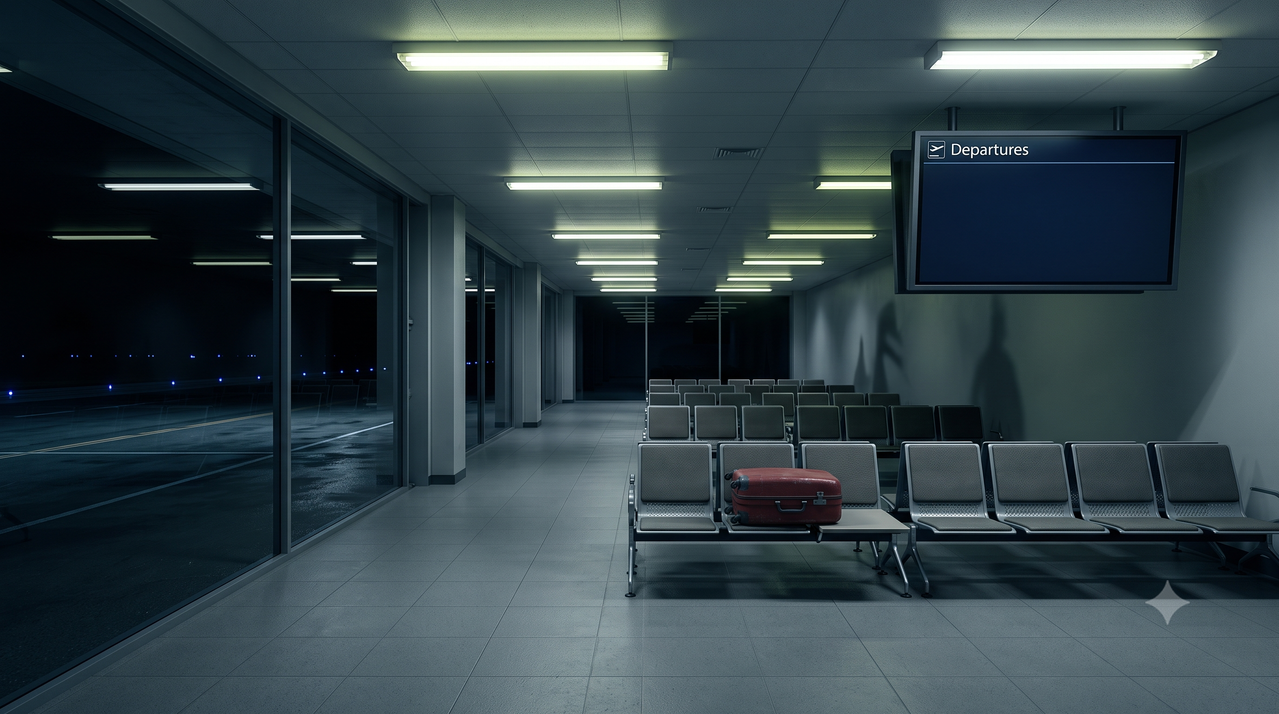
The Departures Lounge
The first one was a woman in a blue coat. Daniel noticed her because she was the only passenger in the departures lounge who wasn't holding a phone. She sat in row G, seat twelve, with a small red suitcase and a boarding pass for the 11:40 to Oslo. He saw her check the departure board, smooth her coat, and then—nothing. He looked down at his security log for perhaps thirty seconds, and when he looked up, row G was empty. The red suitcase was still there. The boarding pass, too, tucked under the armrest. But the woman was gone.
He reported it to his supervisor, a tired man named Fletcher who smelled of coffee and indifference. "Probably went to the bathroom," Fletcher said without looking up from his screen. Daniel pointed out the suitcase, the boarding pass. Fletcher shrugged. "She'll come back. They always come back." Daniel wanted to argue, but the 11:40 was already boarding, and the gate staff were calling final call, and the red suitcase sat untouched as the last passenger filed through the jet bridge and the plane pushed back and the woman in the blue coat did not return.
That was a Tuesday. By Friday, Daniel had counted eleven disappearances.
He worked the night shift at Gate 14, the far end of the terminal, where the fluorescent lights hummed at a frequency that made his teeth ache and the air conditioning never quite reached. It was a liminal space in the truest sense—a corridor between elsewhere and elsewhere, designed to be passed through, not inhabited. The chairs were bolted to the floor. The windows looked out onto a runway that could have been anywhere. Time moved strangely there, stretched thin by the quiet and the lack of natural light. Daniel had worked the same shift for three years and had never quite gotten used to it.
The disappearances were subtle. A businessman in a grey suit, mid-sentence on a phone call, phone clattering to the floor, no one there. A mother with a stroller, the stroller still rocking gently on its wheels, her coffee still steaming on the armrest. A teenage boy with headphones, the music still playing faintly from the plastic cups lying on the seat. Daniel was the only one who seemed to see it happen. He'd look away for a moment—to check a monitor, to answer a question—and when he looked back, a person had been erased. Not dramatically. Not with a scream or a flash of light. Just... gone. The objects they'd been holding remained. Their scents lingered for a few seconds, perfume and sweat and dry-cleaning chemicals. Then nothing.
He started keeping a list. A small notebook he carried in his breast pocket. Eleven names he didn't know, so he invented them: Blue Coat, Grey Suit, Stroller Mother, Headphones. He tried to tell Fletcher again, this time with the notebook as evidence. Fletcher flipped through the pages, his expression unreadable. "Daniel," he said, very slowly, "there are no missing passengers. No one has filed a report. No one has left a bag. Look at the system." He turned his monitor around. The seat assignments for all of Daniel's flights were full. Every passenger accounted for. "I don't understand," Daniel said. "I saw them. The suitcase was right there. The boarding pass was under the armrest." Fletcher sighed and said, "Maybe you should take a few days off. The night shift can get to people."
Daniel didn't take the days off. He went back to Gate 14 that same night and watched more closely. He set up his phone to record the lounge, a low-quality video that would capture nothing but the hum of the lights and the occasional flicker of the departure board. At 2:47 a.m., during a long gap between flights, he reviewed the footage. The lounge was empty. Then, for exactly four frames—a sixth of a second—the screen was full of people. Dozens of them, standing shoulder to shoulder, facing the camera, their faces blank as mannequins. And then the lounge was empty again. He rewatched the clip six times. The faces were not strangers. He recognized Blue Coat. Grey Suit. Stroller Mother. Headphones. And others he hadn't named yet. They were all there, and they were all looking directly at him.
He didn't tell Fletcher. He didn't tell anyone. He went home to his flat, a sparse one-bedroom that overlooked a car park, and sat in the dark with the curtains drawn, the notebook open on his lap. He thought about calling his brother. They hadn't spoken in two years, not since the funeral. Their mother had died in a hospital room that smelled of antiseptic and old flowers, and Daniel had been at the airport when it happened. Working the night shift. He'd told himself he would visit her the next day. The next day she was gone. He had never quite forgiven himself, and his brother had never quite forgiven him either. He picked up the phone. He put it down. He couldn't bear to hear the disappointment in his brother's voice, or worse, the silence that might replace it if his brother didn't pick up at all.
The night he became one of the disappeared, the airport was empty in a way it had never been before. Not a passenger in sight, not a single flight on the board, not a single voice on the intercom. The terminal had the stillness of a photograph, and Daniel walked through it with the slow, deliberate steps of someone who knows he is dreaming but cannot wake up. He passed the shuttered duty-free shops, the dark cafés, the moving walkways that had stopped moving. He reached Gate 14 and found his red suitcase sitting on the seat he always used for his break. He didn't own a red suitcase. He had never seen this one before. But he opened it anyway, and inside was a single item: a boarding pass with his name on it, printed in the familiar sans-serif font, destination left blank.
He turned. The departures lounge was full. Every seat was occupied by the vanished, their faces no longer blank but alive with a kind of hungry recognition. Blue Coat smiled at him, a smile that didn't reach her eyes. Grey Suit raised a hand in greeting, his fingers too long. Stroller Mother wheeled her stroller forward, and inside it was not a baby but a bundle of coats and boarding passes and abandoned phones. "Welcome," she said, and her voice was the hum of the fluorescent lights, "we've been waiting for you. The night shift takes everyone, eventually."
Daniel wanted to run. But he looked at the boarding pass in his hand, at his name printed in neat capital letters, and he felt something give way inside him—the last thread of a rope he'd been clinging to since his mother died, since his brother stopped calling, since he'd started mistaking emptiness for peace. "Where am I going?" he asked. Headphones took a step forward and said, "Where do you think you've been?"
And then the lights flickered once, and the terminal was empty. The red suitcase, the boarding pass, Daniel—all of it gone. Only the security footage remained, a short clip that Fletcher would watch the next morning with a frown, trying to understand why the camera had captured a brief, impossible image: a departures lounge full of people who weren't supposed to be there, and in the center of them, a man in a security uniform, smiling.
Fletcher deleted the footage. He told himself it was a glitch. He posted the job opening for a new night-shift guard the following week.
A month later, a young woman named Amira started at Gate 14. On her second shift, she noticed a red suitcase sitting unattended in row G. She looked around. The lounge was empty. She walked over, opened it, and found a small notebook with twelve names written inside, the last one in fresh ink: Daniel. She didn't understand. She was still trying to understand when her supervisor called her name, and she looked away for just a moment.
When she looked back, the suitcase was gone.
Some spaces hold more than we know. If this story's themes of isolation, grief, and disconnection feel close to home, please remember that you are not as alone as the departures lounge might make you feel. Reaching out can be the first step back toward solid ground.