
The Dripping
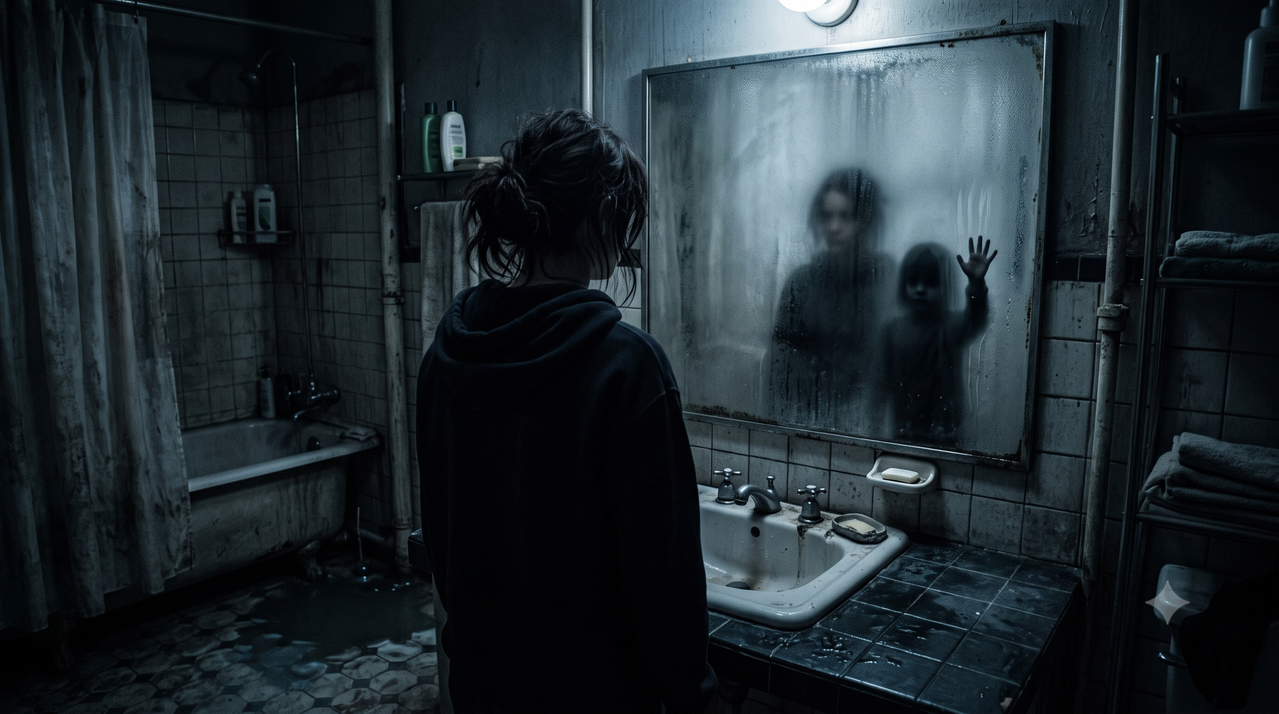
The dripping began on the first night Lena spent alone in the apartment, which was also the anniversary of the day her sister stopped swimming.
She told herself it was the faucet. The building was old, a converted school from the 1920s, and the landlord had warned her that the pipes had personalities. “Nothing to worry about,” he’d said, jangling keys, not quite meeting her eyes. “Just give the tap an extra turn.” So she gave it an extra turn. She gave it three extra turns. At two in the morning, lying on a mattress still bare of sheets, she heard the sound again: a single drop of water hitting a hard surface somewhere in the dark. Pause. Another drop. Pause. Another.
She did not get up. She pressed her palms flat against her stomach and counted the drops the way she used to count her sister’s breaths when they shared a room as children — one, two, three, four — until the sound blurred into a rhythm and the rhythm blurred into sleep.
In the morning, the bathroom floor was dry. The sink was dry. The shower curtain hung limp and undisturbed. Lena stood in the doorway, a toothbrush frozen halfway to her mouth, and felt the first cold finger of something she couldn’t name trace its way down her spine.
She had moved to this city for a job that sounded impressive on paper and paid just enough to cover rent on a studio that used to be a custodian’s quarters. It was a single room with a hot plate, a narrow bed, and a bathroom barely larger than a closet. The one window overlooked a brick wall. The walls were painted the color of weak tea. The mirror above the bathroom sink was original to the building, its silver backing mottled with age, and it showed her a version of herself that looked slightly wrong — paler, thinner, a half-second out of sync.
But rent was cheap, and Lena needed cheap. She needed, more than anything, to be somewhere no one knew her name or the name of the girl who had worn her face for twelve years and then vanished beneath a surface that had once seemed so harmless.
Her twin sister’s name was Iris. They had been inseparable in the way identical twins are supposed to be, and then, at twelve, they weren’t. A lake. A summer camp. A dock that sagged in the middle. Lena swam back to shore. Iris didn’t. For ten years, Lena had carried this fact like a stone sewn into the lining of her coat. She had learned to walk without limping. She had learned to smile. She had learned to never, ever speak about it.
The apartment was supposed to be a fresh start. Instead, it listened.
The second week, the dripping grew teeth. It was no longer confined to the bathroom. Lena would wake to find small puddles on the kitchen counter, perfectly circular, as if someone had pressed a wet glass against the tile. She’d step out of the shower and see handprints on the mirror — small, child-sized — even though she’d wiped it clean before getting in. She’d hear, in the space between sleep and waking, a voice humming a tune she recognized from childhood. A lullaby their mother used to sing. A song she had not thought about in years.
She called the landlord. He came with a toolbox and a frown and spent twenty minutes peering under the sink. “Pipes are dry as bone,” he said. “Must be condensation. Old buildings like this, they breathe.” He left a dehumidifier that rattled like a dying bird and made no difference at all.
She called her mother, once. She didn’t mention the dripping. She didn’t mention the voice. She said, “How are you?” and her mother said, “Fine, busy, you know how it is,” and neither of them said Iris’s name. The silence where that name should have been was louder than any dripping. Lena hung up and sat on the edge of her bed, gripping the phone so hard her knuckles ached.
She almost told Marcus. Marcus was the only person in the city who knew her for longer than a month, a friend from college who had moved here two years earlier and who checked in with the gentle persistence of someone who suspected she was not okay. They met for coffee on a Saturday, and she sat across from him, stirring sugar into her cup until the liquid turned gray. “Do you ever feel like a place is watching you?” she asked. He laughed, but it was a careful laugh. “Like a haunted house kind of thing?” She shrugged, forcing lightness into her shoulders. “Forget it. I’m just not sleeping well.” The moment passed. She let it pass. She couldn’t explain what she didn’t understand, and she couldn’t bear the way his face might change if she tried.
That night, the dripping found a new voice.
She woke at three in the morning to the sound of water running — not a drip, but a steady, low-pressure stream, the kind you hear when someone leaves the bathroom tap open just a crack. She walked to the bathroom on feet that felt bolted to someone else’s legs. The door was ajar. She pushed it open. The sink was running. She was certain she’d turned it off. She’d checked twice, the way she now checked everything twice — the stove, the lock, the mirror. She reached for the handle, and then she saw her reflection.
It wasn’t her.
The girl in the mirror had her face — the same dark hair, the same slight overbite, the same mole beneath the left eye — but her expression was different. She was smiling, a small, expectant smile, the smile of someone waiting to be noticed. Her eyes were not Lena’s eyes. They were Iris’s eyes, wide and brown and lit with a curiosity that had died in dark water ten years ago.
Lena screamed. The sound tore out of her throat and shattered against the tile. She stumbled backward, hit the doorframe, and when she looked again, the reflection was just her. Pale, trembling, one hand clamped over her mouth. The sink was off. The room was silent. But the floor was wet. She was standing in a cold, shallow pool of water that hadn’t been there a moment before.
She didn’t sleep for the rest of the night. She sat on the floor with her back against the wall, watching the bathroom door, waiting for the dripping to start again.
It didn’t. But in the morning, the mirror was fogged, and written in the condensation was a single word, drawn with a small finger: SISTER.
Lena scrubbed it away with a towel and told herself it was a dream. She told herself a lot of things. She told herself the handprints were her own, that she’d been sleepwalking. She told herself the humming was a neighbor’s radio. She told herself the weight that sometimes settled on the foot of her bed at night was just the blanket pulling loose. She was good at this. She’d been practicing for a decade.
But the apartment knew. It had been waiting, she realized later, for someone exactly like her — someone hollowed out by guilt, someone who had never let herself grieve, someone who carried a dead twin inside her like a second heartbeat. The building was old and hungry, and grief was something it could drink.
The night the bathroom door wouldn’t open, she nearly called Marcus again. She stood in the hallway at two in the morning, her phone in her hand, his name lit up on the screen. From the other side of the door, she could hear water — not dripping, not running, but lapping, the sound of a small lake against a wooden dock. She could hear footsteps, light and quick, the way Iris used to pad across their bedroom to climb into her bed after a nightmare. She could smell lake water, green and mineral, and something sweeter beneath it. Shampoo. The strawberry shampoo their mother bought in bulk, the kind they both used until the bottles ran out and Iris was gone and Lena threw the last one away unopened.
She pressed her thumb over the call button. She imagined his voice, groggy with sleep, the way he’d say her name with that careful, worried inflection. She imagined telling him everything — the dripping, the reflection, the word on the mirror, the sister she’d left behind in a lake that didn’t even have a current, just a sudden drop-off where the dock ended and the deep began. She imagined being believed. She imagined being pitied. She didn’t know which was worse.
She put the phone down.
The bathroom door swung open on its own, slow and silent, and the lapping stopped. The room was dark, but she could see the mirror. Her reflection was there, and beside it, another. Smaller. Hair plastered wet to its cheeks. Nightgown clinging to narrow shoulders. Iris, exactly as she had looked the last time Lena saw her alive, one hand raised, palm pressed to the glass from the other side.
Lena raised her own hand. She didn’t mean to. It moved without her permission. Her palm met the mirror, and the glass was cold and hard and somehow soft all at once, and she felt fingers — real fingers, cold and wet and small — curl around her own.
She didn’t pull away.
She stood there, hand to hand with her sister, for what felt like hours or seconds or years, and when she finally blinked, the reflection was only her. The bathroom floor was dry. The air smelled of nothing at all.
The dripping stopped after that night. The puddles, the handprints, the humming — all of it stopped. The apartment was just an apartment again, quiet and small and cheap. But Lena didn’t feel relieved. She felt emptied, like a room whose only occupant had stepped out and left the door open. She called Marcus the next day and told him she was thinking of moving. He offered to help. She said she’d think about it. She stayed another month. Then two. She stopped checking the mirror. She stopped locking the bathroom door. Some nights she woke at three in the morning and sat perfectly still, listening, but there was nothing to hear. The silence was worse than the dripping had ever been.
When she finally did move, she left no forwarding address. The landlord cleaned the apartment himself and showed it the following week to a young woman with tired eyes and a suitcase held together with tape. The woman stood in the bathroom, studying the old mirror with its mottled silver. “Does the plumbing give any trouble?” she asked. The landlord shook his head. “Good as new. Quietest unit in the building.”
That night, alone in the apartment for the first time, the woman woke to a soft, insistent sound she couldn’t place. A single drop of water hitting a hard surface. Pause. Another drop. Pause. She got up, checked the sink, checked the shower. Everything was dry. She went back to bed. And from the bathroom mirror, two small handprints slowly bloomed in the fog that hadn’t been there a moment before.
If the themes of grief, survivor’s guilt, or isolation in this story resonate with you, please know that professional support is available and worth seeking. You are not alone, and you do not have to carry your pain in silence.