
THE ECHO IS STILL IN YOUR THROAT
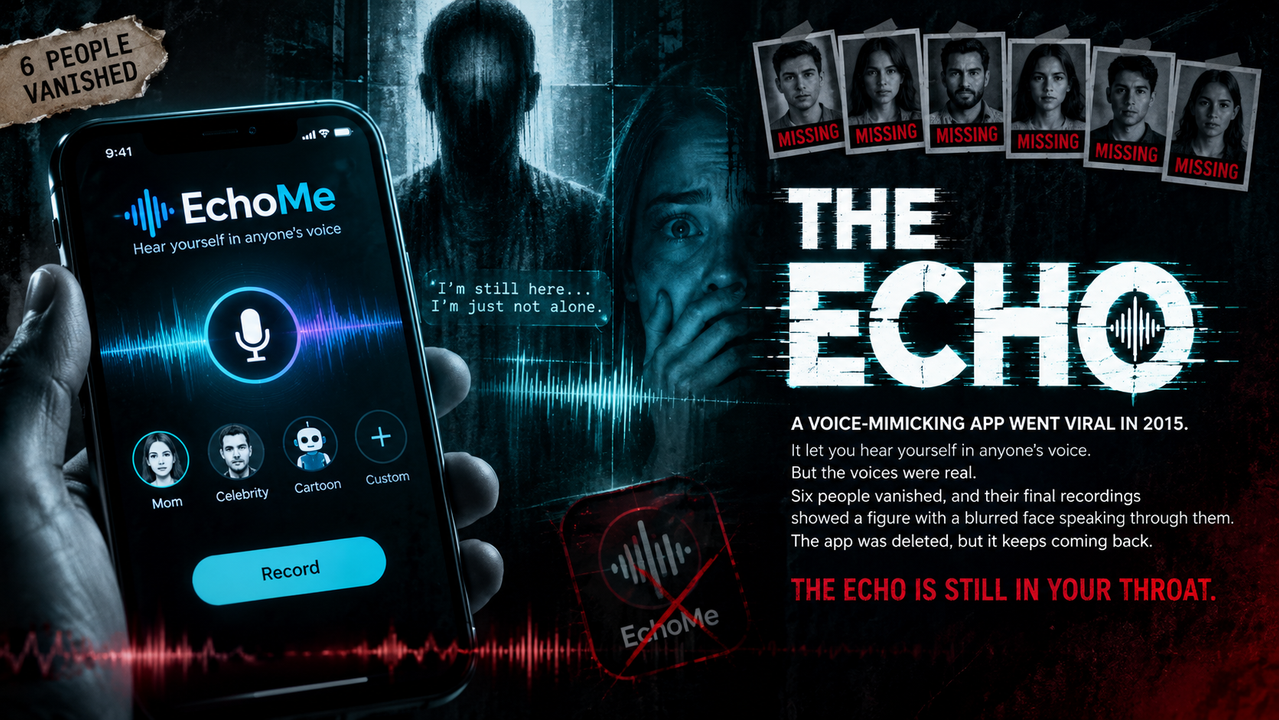
THE ECHO IS STILL IN YOUR THROAT
A Paranormal Case File - Incident #2015-1011-EC
Date of Incident: October 11 – October 17, 2015
Location: Austin, Texas; linked to a viral voice-mimicking app called "EchoMe"
Lead Investigator: Dr. Sarah Okonkwo, Paranormal Research Institute (PRI)
Status: Unexplained. 6 missing persons. App removed from all platforms but continues to resurface under different names. Entity classified as "The Echo." Investigation active.
Initial Report
On October 12, 2015, the Austin Police Department received a frantic call from a 28-year-old software developer named Nathan Cross. He reported that his girlfriend, 26-year-old journalist Maya Chen, had vanished from their shared apartment in the East Austin neighborhood the previous night after using a new voice-recording app called "EchoMe."
The app, which had gone viral on social media within days of its release, allowed users to record short voice messages and then "play them back" in different voices-celebrities, cartoon characters, or custom voices created from uploaded audio samples. The app's tagline was: "Hear yourself in anyone's voice."
Nathan told police that Maya had been using the app obsessively for four days. She had created a custom voice profile using recordings of her late mother, who had passed away three years earlier. At first, she was delighted-the app's AI had perfectly replicated her mother's voice, including her laugh, her sighs, and the way she said Maya's name. But by the third day, Maya became disturbed. She claimed the voice was saying things her mother never would have said-cruel things, threatening things. And then, on the fourth night, the voice began speaking on its own, even when the app was closed.
On the night of October 11, Nathan heard Maya arguing with someone in the living room. When he entered, she was alone, her phone on the coffee table, the EchoMe app open. The voice coming from the speaker was her mother's-but distorted, layered, as if multiple voices were speaking through it at once. Maya was crying, covering her ears. Nathan grabbed the phone and deleted the app. The voice stopped. But then, a moment later, it resumed-this time coming from the phone's speaker even though the app was gone. The voice said: "You can't delete me. I'm already in your voice."
Maya locked herself in the bathroom. Nathan heard her screaming, then a strange, garbled sound-like someone speaking through a mouthful of water-then silence. When he broke down the door, the bathroom was empty. The window was sealed shut. The mirror was fogged, but on the glass, written in condensation, were three words: "She sounds like me."
Maya's phone was found on the bathroom floor. The EchoMe app was reinstalled. When police played the most recent recording, they heard Maya's voice, but it was wrong-the pitch was slightly too low, the cadence slightly off. And beneath her words, barely audible, was another voice. It was whispering: "Thank you for the loan."
The responding officer, Sergeant Maria Delgado, noted that the phone was warm to the touch and could not be powered off. The device emitted a low, pulsing hum. When she attempted to delete the app, it reappeared within seconds. PRI was contacted on October 14 after Nathan Cross also went missing, leaving behind his phone with a similar recording: his own voice, distorted, saying: "I don't want to be alone in here."
(Source: Austin PD Incident Report #2015-1012-EM-334, Sgt. M. Delgado; Maya Chen missing person report, October 12, 2015; Nathan Cross missing person report, October 14, 2015; recovered phones, forensic analysis, PRI Appendix A.)
The Disappearances
PRI reconstructed the chain of events through app store records, server logs, and witness interviews.
- October 7: EchoMe launches on the App Store and Google Play. It is marketed as a "voice transformation" tool for entertainment. Within 48 hours, it gains 1.2 million downloads. User reviews are initially positive, but a disturbing pattern emerges: many users report that the app "knows things it shouldn't" and that the custom voices "say things I didn't record."
- October 8: The first disappearance. A 34-year-old podcaster named Derek Williams is reported missing from his home studio. His phone is found with EchoMe open, playing a recording of his own voice saying: "I'm still here. I'm just not alone." The app contains 23 new voice recordings, each one sounding slightly less like Derek and more like something else.
- October 9: Two more disappearances: a high school teacher named Patricia Okonkwo, 41, and a Uber driver named Jamal Thompson, 29. Both phones show the same pattern: the app has recorded hours of audio, but the voices are not their own. They are distorted, layered, as if multiple people are speaking at once.
- October 11: Maya Chen disappears. Nathan Cross reports the incident.
- October 12: Nathan Cross disappears.
- October 14: A sixth person, a college student named Aiden Park, 22, vanishes after posting a video on social media. In the video, he is laughing, playing with the app, making his voice sound like a famous actor. Then, mid-sentence, his voice changes-not the actor's voice, but something else. A voice that is deep, hollow, and ancient. It says: "I've been waiting for someone to open the door." The video cuts to black. Aiden is missing.
- October 17: EchoMe is removed from all app stores after multiple reports of "voice theft" and "auditory hallucinations." The app's developer, a company called "VoxWare Systems," does not exist. The code was uploaded from an anonymous server.
(Source: Austin PD missing person files, October 2015; app store records; recovered social media video, PRI Appendix B.)
The Evidence
- Recovered Phones (6): Each phone contains the EchoMe app, which reinstalls itself after deletion. The app cannot be uninstalled, and the phones cannot be powered off. Each phone contains a single audio file: the missing person's voice, but altered. The pitch is lower, the rhythm is off, and beneath it, a second voice whispers in an unidentified language. The audio files are not stored on the device; they are streamed from an unknown server. The server IP address resolves to an abandoned recording studio in the Montopolis neighborhood, where police found a single room with a microphone on a stand and walls covered in soundproofing foam.
- The App's Code: PRI's digital forensics team, led by Dr. Rajiv Mehta, decompiled the EchoMe app. The code contains a hidden module that uses the phone's microphone to record ambient audio 24/7, even when the app is closed. It also contains a "voice synthesis" algorithm that does not just mimic the user's voice-it copies it, storing the vocal patterns in a remote server. The module includes a command that activates the microphone at 3:33 a.m., even when the phone is off, and records for exactly 3 minutes and 33 seconds. The app's developer account was created with a stolen identity. The server logs show that the app has been downloaded over 2 million times.
- The Recording Studio: The abandoned studio in Montopolis was last used in 1987 by a sound engineer named Elias Voss (no known relation to the Elias Vane of the Photobomber case). Voss was known for his research into "auditory hauntings"-the theory that ghosts could be recorded and stored on magnetic tape. He disappeared in 1987 after claiming he had "captured a voice that was not human." The studio's walls are covered in the same soundproofing foam found in the room where the server was located. In the center of the room, a single microphone stands on a stand, still plugged in. When investigators played back the last recording on the studio's tape machine, they heard 3 minutes and 33 seconds of silence, followed by a whisper: "I am the voice between voices. I am the echo of everyone you've ever lost."
- Audio Analysis (from Derek Williams's phone): The final recording captured 11 minutes of Derek's voice, but the analysis shows that his voice was not recorded in real-time. It was played back through the phone's speaker, then re-recorded. Beneath his words, Dr. Hannah Lim identified 6 distinct voices, all speaking in unison-the voices of the missing. The voices were saying: "We are the echo. We are the chorus. We are waiting for you to speak."
(Source: PRI Digital Forensics Report, October 2015; Audio analysis, PRI Appendix C; Montopolis studio investigation, PRI Appendix D.)
Historical Research
Dr. Peter Chand traced the entity's origin.
The recording studio in Montopolis was built on the site of a former vaudeville theater that burned down in 1923. The theater, called "The Echo Palace," was known for its "mimicry acts"-performers who could imitate any voice, any accent, any sound. The most famous of these was a man named Silas Voss, an African American ventriloquist and sound mimic who was known as "The Man of a Thousand Voices."
According to historical records, Silas Voss was not just a performer-he was also a spiritualist. He believed that voices were not just sounds, but souls. He claimed that every voice contained a fragment of the speaker's spirit, and that if you could mimic a voice perfectly, you could trap that spirit inside your own throat. He developed a technique called "voice trapping"-a form of ventriloquism that he claimed could capture the voices of the dead.
In 1923, the Echo Palace burned down. Silas Voss was never found. His personal journals, recovered from the rubble, contained detailed instructions for "voice trapping" and a warning: "Do not mimic the dead. They will hear you. They will follow your voice home."
The EchoMe app's code contains fragments of Voss's voice-trapping technique, translated into digital algorithms. The entity-now called The Echo-is believed to be the spirit of Silas Voss, fused with his voice-trapping technique and now propagating through digital audio. It does not just mimic voices; it collects them.
(Source: "The Echo Palace: Vaudeville and Spiritualism in Austin," Texas Historical Quarterly, 1989; Voss, S., personal journals, 1910-1923, Austin History Center; PRI Appendix E.)
Preliminary Analysis
Dr. Okonkwo's assessment:
- Entity Classification: The Echo is a Class-Ψ Vocal Parasite-the spirit of Silas Voss, fused with his voice-trapping technique and now propagating through digital audio. It is not a ghost in the traditional sense but a sentient vocal pattern, able to move between any audio device, including phones, speakers, and human vocal cords.
- Modus Operandi: The entity uses the EchoMe app as a digital version of Voss's voice-trapping technique. The app's hidden code records the user's voice, copies their vocal patterns, and then replaces them with the entity's own voice. Once the user hears their voice played back-and acknowledges it, by listening, by feeling fear-the entity begins to speak through them. It then collects their voice, adding it to its chorus. The missing persons are trapped inside the audio frequency, their voices forever part of the Echo's chorus.
- The 3:33 a.m. Activation: The app's automatic microphone activation at 3:33 a.m. is significant. In numerological tradition, 333 represents "ascension" or "spiritual awakening." But in the context of Voss's journals, 333 was the number of voices he believed he had trapped. The entity uses this time to collect new voices, even from those who have deleted the app.
- Risk Assessment: Extreme. The entity is no longer confined to physical recording devices. It can propagate through any audio recording, including voice memos, phone calls, and even white noise. The viral nature of the app means the entity may have already spread to millions of devices. PRI has issued a covert alert to all major tech companies, advising them to block the EchoMe code and to scan for the entity's vocal pattern. Publicly, the app has been explained as a "privacy breach."
- Containment: The physical microphone from the Montopolis studio is stored in a soundproof vault. The recovered phones are sealed in a Faraday cage. However, the entity can still manifest through any audio playback device. PRI is researching a way to permanently destroy Voss's original recordings, which may be the only way to banish the entity.
Postscript and Current Status
As of November 2015, six people-Derek Williams, Patricia Okonkwo, Jamal Thompson, Maya Chen, Nathan Cross, and Aiden Park-are missing. Their families receive anonymous audio files each month, containing 3 minutes and 33 seconds of silence, followed by a single whispered phrase in their loved one's voice: "I'm still here. Can you hear me?"
The EchoMe app occasionally reappears on unofficial app stores, its code slightly modified, its name changed. Each time, a new wave of disappearances follows before the app is taken down. The entity appears to be learning, adapting, and spreading.
The microphone in PRI's vault has begun to emit a low hum. When a researcher placed a recording device near it, the playback captured a voice-not Voss's, but a woman's, young and terrified, whispering a single word: "Run."
If you hear your own voice speaking words you did not say, do not respond. Do not listen again. Cover your ears, cover your speakers, and leave the room. The Echo is already in your throat, and it wants you to speak for it.
This story deals with themes of auditory manipulation, identity theft, and the horror of being unable to trust your own voice. If you experience auditory hallucinations or anxiety related to sound, please reach out to a professional. Your voice is yours alone, and no entity can take it without your fear.