
The Lantern Room
The Lantern Room
The lighthouse had stood on the headland for a hundred and forty years, but it had been dark for the last twenty, decommissioned and sold into private hands. Mara inherited it from an uncle she had met twice—a quiet, sun-cracked man who had bought the place at auction and then, for reasons no one understood, never spent a single night inside. When the solicitor called, Mara was still deep in the cold year that had swallowed her after the boat sank. She took the keys as a distraction. A place to be alone, far from the pitying faces of her friends, the unread messages on her phone, the silence where Theo’s voice should have been.
She arrived in late November, the sky a bruised grey, the sea hammering the cliffs like a fist against a locked door. The lighthouse was a tall white column with a cottage attached at its base—two rooms, a kitchen with a wood stove, and a narrow spiral staircase leading up to the lantern room. The previous owner had left behind a table, a bed frame, and a single object on the mantelpiece: a leather-bound logbook, its pages yellowed but blank. Mara opened it, ran her fingers over the empty lines, and put it back. She had no energy for old records.
The first night, the light woke her. It came through the bedroom window in a slow, sweeping arc—a beam of pure white that cut through the dark, paused, and swung back. Mara lay frozen, heart knocking against her ribs. The lighthouse had no power. The Fresnel lens had been removed when the station was decommissioned. There was nothing up there that could produce light. She told herself it was a passing ship, a helicopter, a trick of the moon on fog. She pulled the blanket over her head and did not sleep.
The second night, she climbed the stairs.
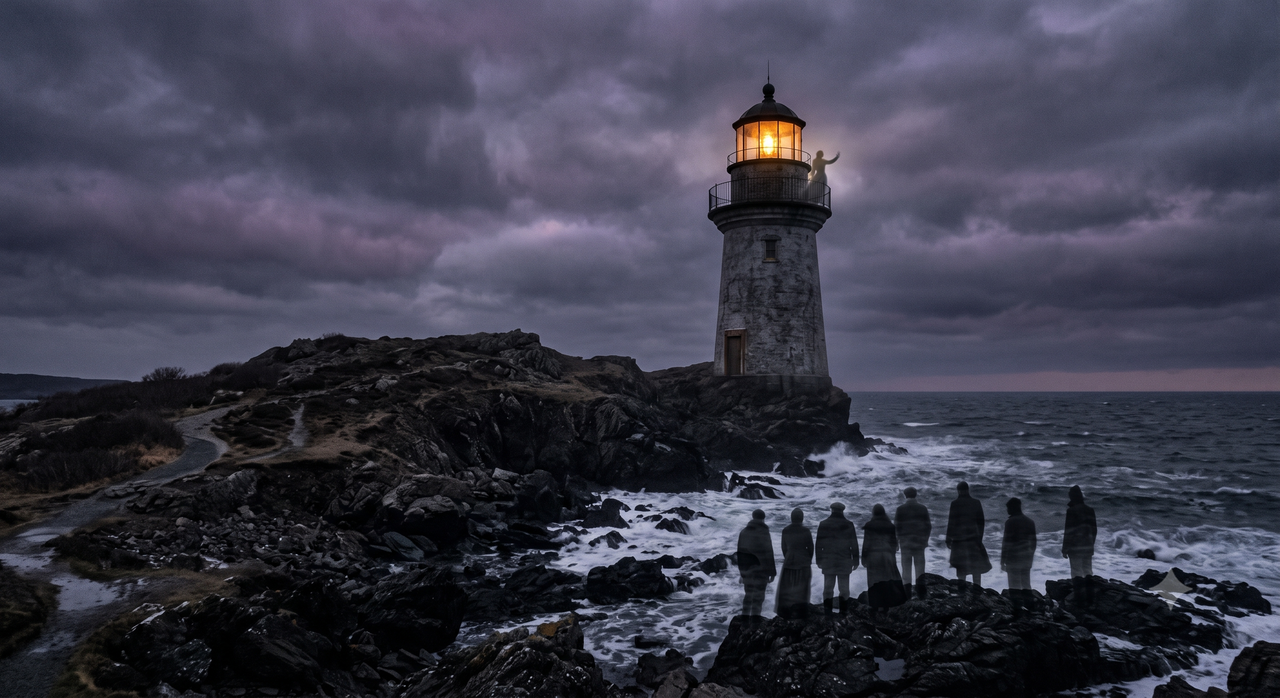
The lantern room was empty—a circular chamber of glass and rusted iron, the floor littered with dead moths and the husks of beetles. The mechanism that had once turned the lens was silent, its gears seized by decades of salt air. No bulb. No power. And yet, when she pressed her palm to the glass and looked out at the sea, the light returned. Not from inside the room. From outside, on the gallery walk, as if someone were standing there with a lantern, sweeping it back and forth across the waves. She threw open the door to the gallery. The wind screamed. The walk was empty. But the beam continued, and in its arc she saw, for one impossible moment, a figure on the rocks below. A woman in a long coat, hair whipping in the wind, arms raised to the sea.
Mara stumbled back inside, slammed the door, and did not go up again for three days.
She almost told Isla, the woman who ran the village shop, when she went down for supplies. Isla had asked, with careful kindness, “How are you finding the old place? Not too lonely up there?” Mara held the edge of the counter, the tin of soup cold in her hand. “It’s fine,” she said. “Quiet.” She wanted to say: There’s a light in the lantern room that shouldn’t exist, and a woman on the rocks who looks the way I felt when the coastguard called, and I think I’m losing my mind. But Isla had a kind face and a warm shop, and Mara couldn’t bear to see that kindness turn to worry. She paid for her soup and walked back up the headland alone.
The logbook was no longer blank.
She found it on the third morning, open on the mantelpiece. The first page was filled with handwriting—a looping, old-fashioned script that she did not recognize. It was a date: November 18th, 1884. Storm came in fast from the north-east. The Sea Lass was two miles out when the fog descended. I kept the lamp burning. I rang the bell. But the fog was too thick, and the sound carries strangely on this headland. They never heard me. Seven souls lost. Beneath it, another entry, same date, different handwriting—smaller, shakier, as if written in haste: Thomas, if you are reading this, I waited all night on the rocks. I saw your light. I saw you. Why didn’t you save him?
Mara read the words until they blurred. She checked the door, the windows, the locks. No one had been inside. The ink was dry. The pages smelled of salt.
The next entry appeared the following morning. This time, it was written in her own handwriting.
I was supposed to be on the boat that day. It was a research trip, three days to the outer islands. I’d packed my bag. At the last minute, I stayed behind to finish a paper. Theo kissed my forehead and said, “I’ll be back before you miss me.” The boat went down in a squall. There were no survivors. I wait for him every night. I watch the sea. I will watch forever.
Mara stared at the page, her hand trembling, because she had not written those words. But she had thought them. Every single one of them, every night, for a year.
She began to understand. The lighthouse was not haunted by the woman on the rocks. It was haunted by all of them—every soul who had ever waited for someone who never came back. The keeper in 1884 who watched the Sea Lass sink. The woman on the shore who lost her Thomas. And now Mara, who had found a lighthouse the way grief finds a quiet room and fills it with echoes.
The light in the lantern room grew brighter each night. She stopped climbing the stairs and sat instead by the window, watching the beam sweep across the water, and in its path she saw them: the figures on the rocks, dozens of them now, women and men and children, all facing the sea, all waiting. The lantern room was their vigil, and the lighthouse had never truly gone dark. It had only been waiting for someone who could see.
She left the lighthouse in spring. Not because the haunting stopped, but because she learned to carry it. She returned to the city, to her work, to the life Theo had wanted her to keep living. She told no one about the lantern room. But once a year, on the anniversary of the sinking, she drives back to the headland and climbs the stairs and stands in the empty chamber, and the light comes, and she sees the woman on the rocks raise her hand in greeting.
The logbook is still on the mantelpiece. The pages are still filling, slowly, in handwriting that changes each time. The last time Mara checked, a new entry had appeared at the bottom of the last page, in a script that looked exactly like Theo’s.
I see your light. I’m coming home.
She closed the book and put it back on the shelf. She did not allow herself to hope. But she did allow herself to wait.
The lighthouse is still there. The headland is now a tourist spot, and visitors sometimes ask the guide why the lantern room seems to glow at dusk, even though the mechanism is broken. The guide smiles and says something about refraction, about the angle of the setting sun.
She knows the truth. But she’s learned that not all truths need to be spoken.
Grief can feel like a lighthouse on an endless coast—a signal that never stops calling out for what we’ve lost. If you’re carrying that weight, please reach out. The right listener can be the difference between waiting alone and finding your way back to shore.