
The Last Train
The Last Train
Everyone who works the late shift in this city knows about the last train. Not the one they list on the schedule—the real last train, the one that comes ten minutes after the official service ends, when the platforms are empty and the ticket machines have gone dark. You don’t catch it on purpose. It catches you.
My coworker Kieran told me about it my first week. We were closing up the diner on Armitage, wiping down counters, the neon buzzing its tired pink hum. “If you ever miss the 1:15,” he said, not looking at me, “and you hear another one coming, don’t get on. No matter how cold it is. No matter what you see inside.” He wouldn’t say why. He just dried his hands on his apron and walked out into the snow.
I laughed it off. I’d lived in this city three years. I knew the sounds the El makes at night—the screech of metal on metal, the hollow clatter over the bridge. I knew the rats on the tracks and the man who sleeps on the platform bench wrapped in garbage bags. I didn’t believe in ghost trains. Then, in February, I missed the 1:15.
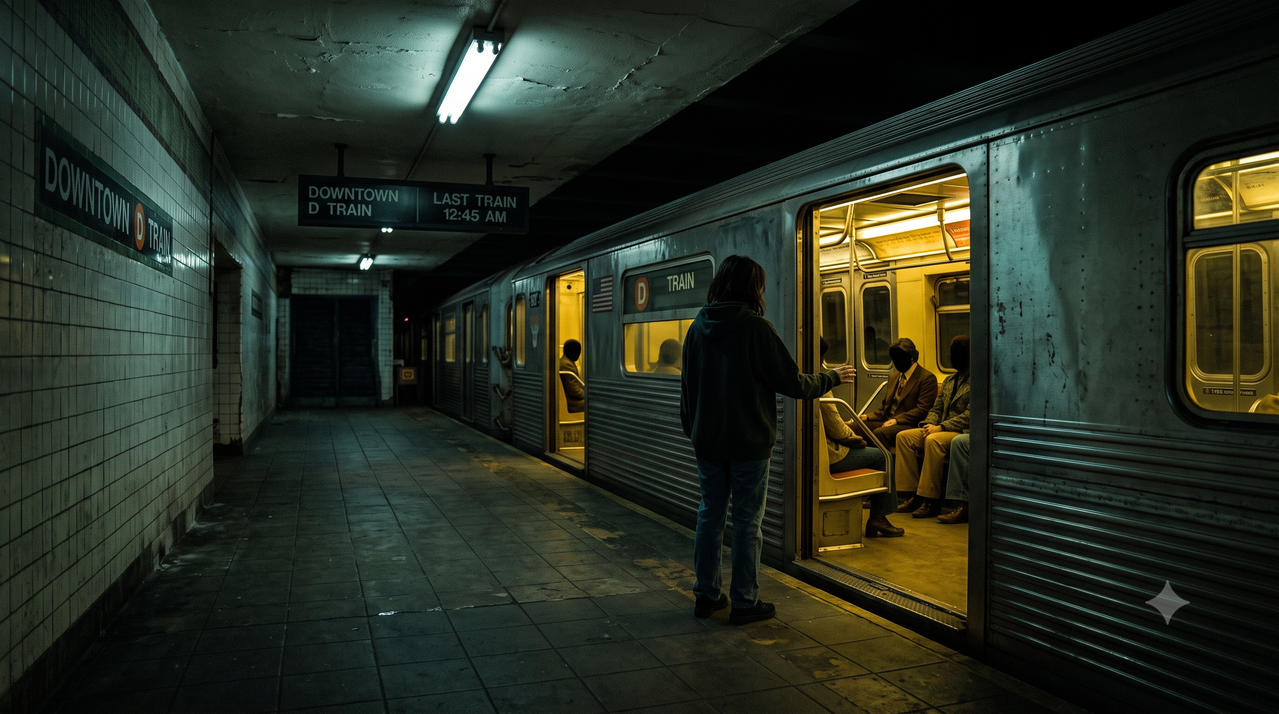
I ran down the stairs as the tail lights disappeared into the tunnel. The platform was empty. The wind cut through my coat. I checked my phone: 1:27 a.m. Useless. I was about to call a rideshare when I heard it—a low hum, then the rattle of an approaching train. No headlight. No announcement. Just a silver car sliding out of the dark, silent except for the hiss of its doors opening.
The lights inside were dim, a sickly yellow. Every seat was occupied. Men and women sat shoulder to shoulder, staring straight ahead, dressed in clothes that looked twenty years out of date. No one spoke. No one moved. I stood on the platform, frozen, one hand on the doorframe. A woman near the door turned her head slowly and met my eyes. Her lips were blue. She smiled, and I saw that her teeth were black, and I ran.
I ran up the stairs two at a time, through the turnstile, into the street. I didn’t look back. I told myself it was an unscheduled maintenance train, a prank, a hallucination from too many double shifts. But when I got home and looked in the bathroom mirror, my reflection was crying. I wasn’t.
That was six months ago. I’ve since learned the legend properly, from a bartender who heard it from a nurse who heard it from a conductor who retired early and never explained why. The last train picks up the ones who died waiting. The overdoses on the bench. The heart attacks on the stairs. The woman who slipped onto the tracks in 1987 and was never quite found in one piece. They’re all still riding, because no one told them service ended. And if you get on, even for one stop, you’ll see them. And they’ll see you. And they’ll remember.
I haven’t taken the El after midnight since that night. But sometimes, when I’m lying in bed, I hear a train horn in the distance—one long, low note—and I check the clock. It’s always 1:37. And I always check my reflection. Just to make sure it isn’t smiling.
Be careful out there. The city is older than you think. And some schedules were never meant for the living.
If this story stuck with you, good. The best urban legends do. But if you're carrying a heavier fear—one that follows you home—please know that reaching out is not a weakness. Support is real, and it's waiting.