The Maw Episode 1: The Temple of the Devouring Maw
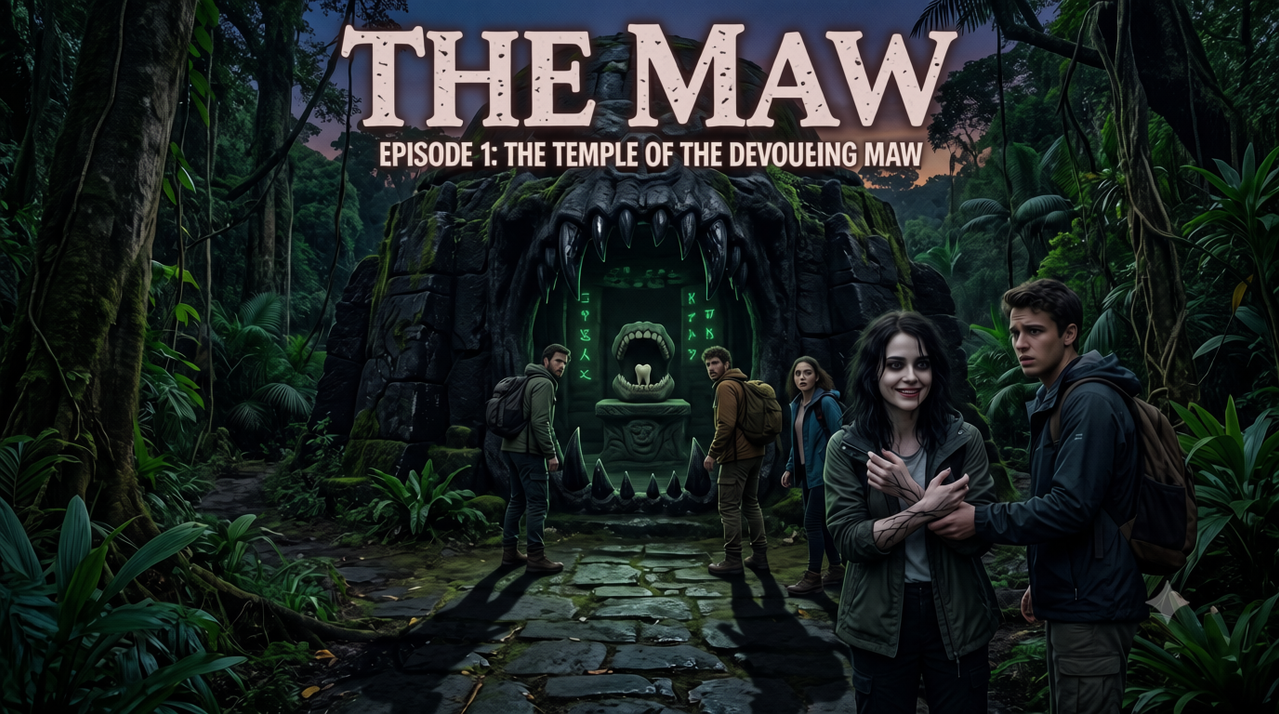
Episode 1: The Temple of the Devouring Maw
A GhastlyPages Original Horror Series — Season of the Blackened Bone
We were four friends who thought a weekend in the jungle would be an escape. By the time the sun went down on the first day, we understood that some doors, once opened, never close again. And the thing we woke up was hungry.
My name is Raj. I’m the one writing this down because someone has to, before I forget what’s real. The other three—Meera, Dev, and Nisha—are still with me, at least in body. But something is wearing them now, one by one. I can see it in the way their shadows fall the wrong way, and how their smiles don’t stop at the corners of their mouths anymore.
It started with a map Dev found in his grandfather’s trunk—a brittle, yellow parchment showing a section of the Brahmagiri jungle that wasn’t on any modern survey. A red circle marked a place deep inside, labeled in a script none of us recognized. Dev said it looked like “Brahmi mixed with something older.” We laughed. We called it the “hidden treasure.” We were idiots.
We drove six hours from the city, parked at the forest checkpoint, and hiked three miles into the green dark. The jungle was ancient. Trees twisted into shapes that made you think of screaming faces. The air was thick, wet, and carried a smell I can only describe as old meat and crushed petals. Birds didn’t sing. The silence was absolute, broken only by our chatter and the snap of twigs under our boots.
At noon, we found the clearing. It was a perfect circle of black soil where nothing grew. In the center stood a temple—if you could call it that. A low, domed structure of dark stone, its entrance a gaping arch shaped like a mouth, studded with what looked like teeth carved from obsidian. The ground around it was littered with small animal bones, bleached white, some still wet. Meera, who was training to be a biologist, knelt and picked up a femur. “This is fresh,” she said. “Maybe a monkey. But something chewed on it. Something with a lot of force.”
Dev, ever the adventurer, was already at the entrance, shining his flashlight into the darkness. “There’s an altar inside! And something written all over the walls.” Nisha, the cautious one, grabbed his arm. “Maybe we shouldn’t. This place feels wrong.” We all felt it—a low, thrumming pressure in the air, like standing too close to a massive speaker. But curiosity is a knife that cuts the hand that holds it.
We went inside.
The interior was small, circular, maybe fifteen feet across. The walls were covered from floor to ceiling with dense, interlocking lines of script that seemed to shift when you weren’t looking directly at them. In the center, a black stone altar rose to waist height. Its top was carved into the shape of a gaping mouth—jaws open, tongue extended, a hollow throat plunging into darkness. Resting on the tongue was a single, perfectly preserved human tooth. It was enormous, a molar, but scaled up to the size of a fist, its roots twisted into a shape that resembled a crouching figure. It gleamed wetly in the beam of our flashlights.
“It’s a replica,” Dev said, but his voice cracked. “Some kind of sculpture.”
Meera reached out and touched it. The moment her fingertip made contact, the temple’s interior temperature plummeted. Our breath fogged. The script on the walls began to glow faintly, a sickly green like fireflies trapped in glass. From the hollow throat of the altar came a sound—a deep, grinding inhalation, as if the stone itself had taken a breath after centuries of holding it.
Then the tooth cracked. A thin line split its surface, and from the fissure oozed a black, viscous fluid that moved against gravity. It flowed up Meera’s hand, quick as a spider, and disappeared into the skin of her wrist. She screamed—a short, choked sound—and pulled back. The tooth fell onto the altar, its crack sealing shut. The glow died. The breathing stopped. And Meera was standing there, staring at her hand, which now bore a faint, branching mark like a black vein just beneath the surface.
“I’m okay,” she said, too quickly. “It’s nothing. Let’s get out of here.”
We scrambled out of the temple into the daylight, which suddenly seemed weaker, as if the sun had dimmed a few notches. No one spoke as we hiked back to the clearing where we planned to camp. We set up tents in a daze. Dev tried to joke about “cursed tooth fairies,” but nobody laughed.
The first night, the noises started.
It began with a low chanting, somewhere deep in the trees. Not words, exactly—more like the sound of a throat being forced to shape syllables it wasn’t meant to speak. It came from all directions at once, then from inside our heads. Nisha complained of a headache. Dev said he felt like he was being watched from the darkness beyond the fire. Meera sat apart, silent, cradling her wrist. I asked to see the mark. She refused.
At 2:13 AM, I woke to find Meera standing over me. Her eyes were open, but the pupils had bled outward, turning the whites into a muddy dark grey. She smiled, and the smile was too wide—the corners of her mouth stretched until the skin at the edges split and wept a thin, pink fluid.
“The Maw is awake,” she said, in a voice that was hers but layered with something deeper, like rocks grinding at the bottom of a river. “It wants to taste. It wants to wear us.”
I screamed. Dev and Nisha woke, and Meera collapsed, unconscious. When she came to a minute later, she had no memory of it. But the cracks at the corners of her mouth were still there, beading with blood.
We decided to leave immediately. We abandoned our gear and started hiking toward the car in the dark. That’s when we realized the trail was gone. Not hidden—gone. The trees had shifted. The landmarks we’d memorized no longer existed. We walked for hours and always ended back at the clearing with the temple. Dev tried his GPS; it displayed nothing but static and a single, repeating coordinate: the temple.
At dawn, we were exhausted and terrified. Meera was getting worse. The black veins had spread up her arm to her shoulder and neck. She kept whispering to herself in a language none of us knew, and sometimes she’d stop and tilt her head, listening to something we couldn’t hear.
Dev found the first mark on his own body—a small black line on his palm, like a splinter. He’d touched the altar while pulling Meera away. He didn’t say anything, but I saw him staring at it, his face pale.
I’m writing this from inside my tent. The chanting has started again. Nisha is crying silently, holding a pocketknife like it can protect her. Dev is sitting by the dead fire, carving symbols into the dirt with a stick, his eyes glassy. And Meera is standing at the treeline, facing the temple, perfectly still.
The mark on my own hand appeared an hour ago. I don’t know how. I never touched the tooth. But I can feel it moving, a cold worm under my skin, inching toward my heart.
I think the tooth was never a tooth. I think it was a seed. And we are the soil.
The Maw is hungry. It’s been waiting in that altar for thousands of years, and we walked right into its mouth. I can hear it now, not with my ears but inside my bones, a grinding, churning voice that speaks in fractures of language: “You are the first course. There will be others. You will bring them. Or you will be the feast.”
The fire has gone out. Dev is standing now. He’s walking toward Meera, and he’s smiling that same too-wide smile.
There is no escape from this jungle. The map brought us here for a reason. Dev’s grandfather never found the temple. He only drew the circle. Because something drew it for him.
I’m going to burn the map. Maybe that will end it. But I can hear Dev laughing, and it’s not his laugh anymore. It’s a wet, choking sound, like meat being pulled apart.
If you find this journal, don’t follow us. Don’t look for the temple. Don’t touch the black stone. And if you see a tooth that’s too big, a mouth that shouldn’t be there—run. Run and don’t look back, because the Maw doesn’t just eat your flesh.
It eats everything you ever were, and leaves something else wearing your skin.
End of Episode 1 — Next: Episode 2: "The Flesh That Speaks"