
The Phone in the Basement
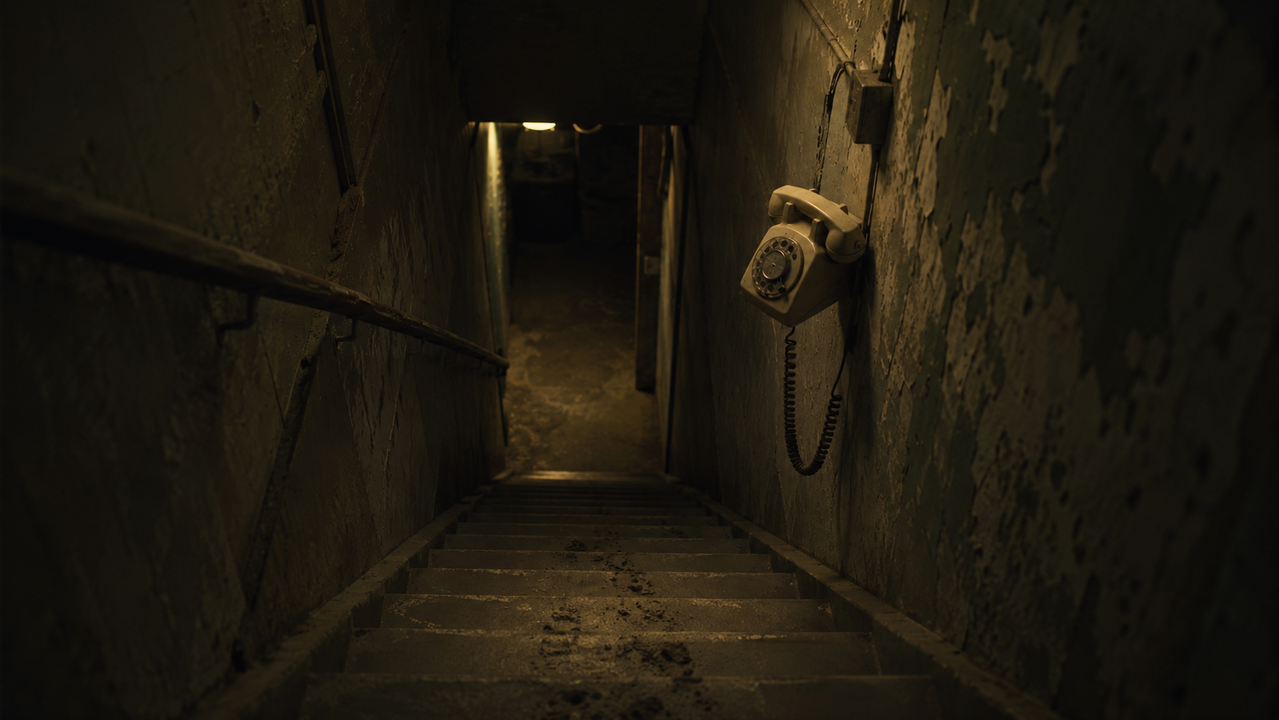
The Phone in the Basement
The phone started ringing on a Tuesday night in February, and Mira was alone in the house except for her mother, who had forgotten what a phone was six months ago.
It was a little past two in the morning when the first call came. The sound cut through the dark like something alive — a shrill, mechanical bleat that didn’t belong in a house where the only working phones were the cordless in the kitchen and Mira’s cell on the nightstand. Both of those were silent. The ringing came from somewhere else. From below. From the basement.
Mira lay still, listening, her breath a white ghost in the cold bedroom air. The furnace had been acting up and the old split-level house on Sycamore Court never held heat well. She counted the rings. Six. Eight. Ten. Then silence. She didn’t go downstairs. She told herself it was the neighbor’s dog, the wind in the vents, a dream. In the morning she made oatmeal for her mother and did not mention it.
The second night, the phone rang again. Two-seventeen. Twelve rings this time, and between the rings she heard something else — a soft click, like a receiver being lifted. Then nothing. Mira sat up, heart beating in her throat. The basement door was in the hallway just outside her bedroom. She’d locked it before bed. She always locked it now. Not because she was afraid of intruders, but because her mother had started wandering at night, and the basement stairs were steep and unlit. That was the reason. The only reason.
She put her feet on the cold floor and walked to the door. Pressed her ear against the wood. From the other side: a low hum, the kind an old landline makes when left off the hook. She could hear it breathing. She went back to bed and pulled the covers over her head like a child.
The phone had been her father’s. Installed in the basement workshop in 1987, a rotary model the color of old butter, bolted to the wall beside his workbench. He’d spent hours down there, fixing clocks, building birdhouses, drinking coffee from a thermos that tasted permanently of metal. When he died — aneurysm, sudden, while Mira was in her sophomore year of college — the basement became a storage space. Boxes of Christmas decorations. Her mother’s abandoned sewing machine. The phone, disconnected a decade ago, still hanging on the wall because no one had bothered to take it down.
Mira had moved back home eleven months ago, after the diagnosis. Early-onset Alzheimer’s at fifty-nine. Her mother could still feed herself, still recognize Mira most days, but the edges were crumbling. She’d ask the same question four times in an hour. She’d forget that Mira was her daughter and call her by a stranger’s name — Susan, Irene, the nurse. She’d stand at the window and watch the cul-de-sac with the stillness of someone waiting for a ride that would never come.
Mira’s sister Jenna lived in Portland and called twice a week. “How are you holding up? Do you need me to fly out?” Her voice was full of genuine concern and genuine distance. Mira always said the same thing: “We’re managing. Don’t worry.” She never mentioned the basement. She never mentioned that she’d started sleeping with the hallway light on.
By the fifth night, the ringing had become a pattern. Two o’clock, sometimes a few minutes after. Always the same number of rings — twelve — followed by the click of the receiver lifting, followed by the hum. And now, something new: footsteps. Slow, deliberate footsteps ascending the basement stairs. They’d stop just before the door. Mira would lie frozen, staring at the strip of darkness beneath it, waiting for a shadow to break the light. It never did. But she could hear breathing on the other side — a wet, labored sound, like someone with a chest cold pressing their mouth to the wood.
During the day, she functioned. She made meals, administered medication, watched game shows with her mother on the sofa. But her mind was in the basement. One afternoon, while her mother napped, she unlocked the door and went down. The stairs groaned under her weight. The air was cold and smelled of sawdust and rust. The phone hung on the wall, gray with dust, its coiled cord dangling like a dead snake. She picked up the receiver. No dial tone. Just silence. She set it back in its cradle and stood there, breathing, until the water heater kicked on and startled her into flight.
That evening, she almost told Jenna. They were on the phone, Jenna describing a restaurant she’d tried, a man she’d met, a life that sounded like a movie Mira had once watched and forgotten the ending of. “I’ve been hearing things at night,” Mira said, cutting in. Jenna stopped. “What kind of things?” A long pause. Mira looked at the basement door. “The house settling. Creepy old pipes. You know.” Jenna laughed, relieved. “God, I don’t know how you do it. That house always gave me the creeps.” Mira forced a smile into her voice. “You get used to it.” She hung up and pressed her palms against her eyes until she saw stars.
She researched the house’s history. No deaths on the property, no tragedies she didn’t already know about. The phone company confirmed the landline had been disconnected in 2014. “There’s no current service at that address,” the representative said, her voice bright and unbothered. “Would you like to sign up for a bundle?” Mira hung up and laughed, a short, brittle sound that didn’t feel like her own.
The first time she saw the door open, it was nearly three in the morning. She’d woken to the ringing, as usual, but this time the footsteps didn’t stop at the top of the stairs. She heard the basement door creak — she’d forgotten to lock it, had she? — and then the footsteps were in the hallway, slow and heavy, moving past her bedroom toward the living room. She held her breath. She heard the creak of the recliner, her father’s recliner, the one no one had sat in since 2012. She heard a sigh, deep and weary, the kind a man makes after a long day. She did not leave her room. She pressed her fist against her mouth and did not make a sound.
In the morning, the recliner was in the reclined position. The TV remote was on the armrest, angled toward the screen. Her mother, sitting at the kitchen table with a bowl of untouched oatmeal, looked up and said, “Your father came home late last night. Is everything all right?”
Mira’s stomach dropped. “Dad’s not here, Mom.” Her mother blinked, confusion swimming through her eyes. “Oh,” she said. “I must have dreamed it.” She went back to her oatmeal, stirring it into paste.
Mira started locking the basement door again. She started pushing the recliner against the wall before bed, only to find it pulled out each morning. She started hearing her father’s cough — a dry, phlegmy hack she’d heard a thousand times growing up — through the heating vents. She lost weight. She stopped answering Jenna’s calls. The house on Sycamore Court became a sealed container, and inside it, two women and something else sat waiting for the phone to ring.
One night, Mira didn’t go to bed. She sat in the kitchen with the lights off and a cup of cold tea, watching the basement door. At two o’clock, the phone rang. Twelve rings. Click. Hum. Footsteps. The door handle turned. She watched it rotate, a slow quarter-turn, and then the door swung inward. The darkness beyond it was absolute. She could feel someone standing there, just beyond the threshold, looking at her.
She spoke into the dark. “Dad?”
The hum from the phone grew louder, filling the house like pressure before a storm. She heard the recliner creak in the living room behind her, but she hadn’t seen anything pass. The basement door closed. Softly. Gently. As if someone were tucking her in.
She didn’t sleep that night. In the morning, she called a home care agency and arranged for a live-in nurse. She packed a bag. She told her mother she was going on a short trip, and her mother nodded and said, “Tell your father I said hello.”
Mira stayed with a friend in Chicago for three weeks. The first two nights, she slept fourteen hours. She ate real meals. She walked along the lake and let the wind scrub her clean. She didn’t tell anyone about the basement. She practiced forgetting.
Then the nurse called. A capable woman named Ruth, with twenty years of experience and a voice like pressed linen. “Your mother’s doing well,” she said. “Just one odd thing. She keeps asking me to answer the phone in the basement. Says it rings every night at two and your father doesn’t like to be kept waiting. I’ve checked, of course — there’s no line down there.”
Mira closed her eyes. “I know,” she said. “There never was.”
She ended the call and sat on the edge of her friend’s guest bed, staring at the wall. The lake glittered outside the window, clean and cold and indifferent. She thought about her mother, alone in the house with a nurse who didn’t believe in ghosts, and her father waiting on the other end of a line that had no service.
She booked a train home the next morning. She didn’t know what she would do when she arrived. She only knew that some calls don’t stop ringing just because you leave the house.
If the themes of caregiver burnout, isolation, or family grief in this story resonate with you, please know that support is available. Speaking with a trusted friend, a support group, or a mental health professional can make a profound difference. You don’t have to carry it alone.