
The Photobomber
The Photobomber
A Paranormal Case File — Incident #2015-1208-CA
Date of Incident: December 8 – December 10, 2015
Location: San Francisco Bay Area, California; linked to a rogue photo-sharing app called "Mirrorgram"
Lead Investigator: Dr. Elaine Voss, Paranormal Research Institute (PRI)
Status: Unexplained. 5 missing persons. App removed from all platforms but self-reinstalling. Entity classified as "The Photobomber." Investigation active.
1. Initial Report
On December 9, 2015, the San Francisco Police Department received a 911 call from a distraught woman named Emily Tran, 26, a graphic designer who lived alone in a small apartment in the Mission District. Emily claimed that her best friend, 27-year-old Marcus Webb, had vanished from his apartment the previous night after using a new photo app called "Mirrorgram." The app, which had briefly gone viral before being pulled from stores, used the phone's camera to apply "ghost filters"—overlays that made it appear as though spectral figures were standing behind the user.
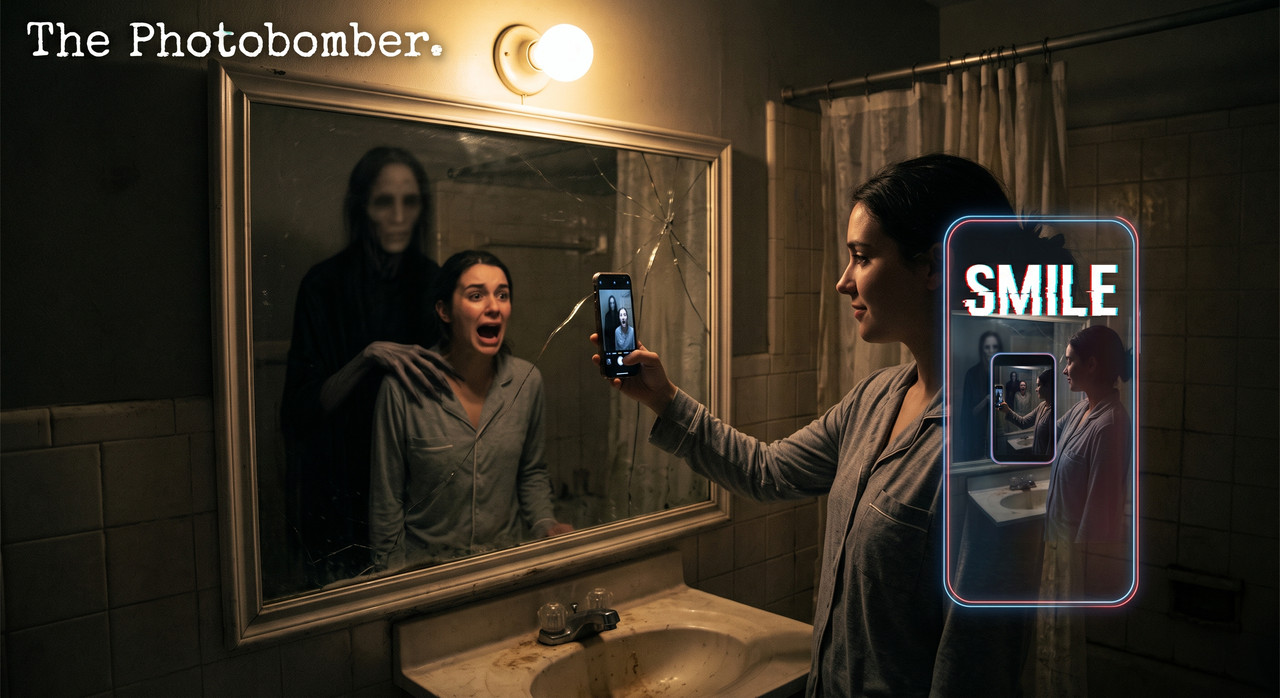
Emily told police that Marcus had been obsessed with the app for three days, taking hundreds of selfies, each one showing a different ghostly figure behind him. At first, he thought it was a joke. Then the figures began to change. Instead of cartoonish spooks, they became more realistic—gaunt, pale, with hollow eyes and mouths stretched into silent screams. And in every photo, the same figure appeared: a tall, thin man with a blurred face, standing directly behind Marcus, his hand reaching toward Marcus's shoulder.
On the night of December 8, Marcus called Emily, hysterical. He said the figure had moved. In his latest photo, the hand was touching his shoulder. And when he looked in the mirror, he saw the figure standing behind him—not in the app, but in the real world, reflected in the glass. He locked himself in his bathroom. Emily heard him screaming, then a wet, tearing sound, then silence. When police arrived, the apartment was empty. Marcus's phone lay on the bathroom floor, the Mirrorgram app open, showing a single photo: Marcus, his face frozen in terror, with the figure's hand now closed around his throat.
The responding officer, Sergeant Daniel Reeve, noted that the bathroom mirror was cracked from the inside, and that a thin layer of a black, tar-like substance coated the sink. The phone was warm and could not be turned off. The app, which had been deleted from the store, had reinstalled itself. PRI was contacted on December 10 after Emily Tran also went missing, leaving behind her phone with a similar photo: her own face, screaming, with the same figure behind her, its faceless head tilted as if curious.
(Source: SFPD Incident Report #2015-1209-MG-778, Sgt. D. Reeve; Emily Tran missing person report, December 10, 2015; recovered phones, forensic analysis, PRI Appendix A.)
2. The Disappearances
PRI reconstructed the chain of events through phone records, social media posts, and witness interviews.
- December 5: Mirrorgram launches on the App Store and Google Play. It is a simple novelty app with a library of "ghost overlays" that can be added to selfies. Within 24 hours, it gains 500,000 downloads. User reviews are mixed, but many report that the app "feels wrong" and that the ghosts "look too real."
- December 6: The first disappearance. A college student named Lena Park, 21, is reported missing from her dorm room. Her phone is found with the Mirrorgram app open, showing a photo of Lena in her room, the same tall figure behind her, its hand on her head. The app has 17 new selfies, each one showing the figure closer.
- December 7: Two more disappearances: a software engineer named Jake Morrison, 29, and a barista named Mia Novak, 24. Both phones show the same figure, the same progression of closeness.
- December 8: Marcus Webb disappears. Emily Tran reports the incident.
- December 9: Emily Tran disappears. A fifth person, a delivery driver named Carlos Mendez, 33, vanishes after taking a selfie outside a coffee shop. His phone shows the figure reflected in the shop window behind him, its hand extended toward his head.
- December 10: Mirrorgram is removed from all stores after a user's livestream shows the figure stepping out of the phone screen and into the room. The livestream cuts to black. The user, a teenager named Lily Chen, is missing.
(Source: SFPD missing person files, December 2015; app store records; recovered livestream VOD, PRI Appendix B.)
3. The Evidence
- Recovered Phones (5): Each phone contains the Mirrorgram app, which reinstalled itself after deletion. The app cannot be uninstalled, and the phones cannot be powered off. Each phone displays a single photo: the missing person, their face frozen in terror, with the figure's hand on their shoulder or head. The photos are not stored in the phone's memory; they are streamed from an unknown server. The server IP address resolves to an abandoned building in the Bayview district, where police found a single, empty room with a mirror on one wall.
- The App's Code: PRI's digital forensics team, led by Dr. Samir Patel, decompiled the Mirrorgram app. The code contains a hidden module that uses the phone's camera to scan for "low-frequency visual patterns" that are invisible to the naked eye. When the pattern is detected, the app generates a "ghost" overlay that is not a random image but a capture of an actual entity. The module also includes a command that activates the camera at 3:03 a.m., even when the phone is locked, and takes a photo automatically. The app's developer, a company called "Phantomware," does not exist. The code was uploaded from an anonymous server, and the developer account was created with a stolen identity.
- The Mirror in the Abandoned Building: The mirror in the Bayview building is 6 feet tall, framed in tarnished brass, and cracked in a spiral pattern from the center. When a PRI researcher stood before it, their reflection showed the figure standing behind them, its hand on their shoulder. The researcher turned; there was nothing there. The mirror is now stored in a light-proof vault. It is cold to the touch and emits a low hum at 15 Hz.
- Audio Recording (from Marcus Webb's phone): The phone's final voice memo captured the sound of the wet, tearing noise, followed by a low, chattering whisper: "You saw me. Now I see you. Smile." Dr. Hannah Lim's analysis shows the whisper is composed of 5 distinct voices, all speaking in unison—the voices of the missing.
(Source: PRI Digital Forensics Report, December 2015; Audio analysis, PRI Appendix C; Material analysis of mirror, PRI Appendix D.)
4. Historical Research
Dr. Peter Chand traced the figure's origin.
The figure matches descriptions of a 19th-century spirit called "The Watcher in the Glass," documented in spiritualist circles in San Francisco during the Gold Rush. According to accounts, a photographer named Elias Vane discovered that a particular type of silver-backed mirror, made with mercury and human blood, could capture the spirits of the dead. He created a series of "spirit mirrors" that became popular among the city's elite. But Vane became obsessed with the mirrors, spending hours staring into them, until one day he was found dead in his studio, his face frozen in a silent scream, his reflection permanently etched into the glass. The mirrors were sold, and their owners began to disappear.
The mirror in the Bayview building is believed to be one of Vane's original spirit mirrors. The Mirrorgram app, coded by an unknown entity or a descendant of Vane, uses the phone's camera as a modern-day silver mirror, allowing the entity—now called the Photobomber—to reach through the glass and claim victims.
(Source: San Francisco Historical Society, "The Spirit Mirrors of Elias Vane," 1892; Vane, E., personal letters, 1852-1875, Bancroft Library; Bayview property records, 1900-2015, PRI Appendix E.)
5. Preliminary Analysis
Dr. Voss's assessment:
-
Entity Classification: The Photobomber is a Class-Ω Mirror-Bound Predator—the spirit of Elias Vane, fused with his spirit mirrors and now propagating through digital cameras. It is not a ghost in the traditional sense but a sentient reflection, able to move between any reflective surface, including phone screens, computer monitors, and still water.
-
Modus Operandi: The entity uses the Mirrorgram app as a digital version of Vane's spirit mirror. The app's hidden code activates the camera, scans for the entity's frequency, and displays it as a "ghost filter." Once the user sees the figure and acknowledges it—by taking a selfie, by viewing the photo, by feeling fear—the entity becomes real for that user. It then moves closer in each subsequent photo, until it is able to reach through the glass and pull the victim into the reflective surface. The missing persons are trapped inside the mirror, their reflections forever screaming.
-
The 3:03 a.m. Activation: The app's automatic camera activation at 3:03 a.m. is significant. In spiritualist tradition, 3:00 a.m. is the "witching hour," when the veil between worlds is thinnest. The entity uses this time to capture new victims, even those who have deleted the app.
-
Risk Assessment: Extreme. The entity is no longer confined to physical mirrors. It can propagate through any digital image, including those shared on social media. The viral nature of the app means the entity may have already spread to millions of devices. PRI has issued a covert alert to all major tech companies, advising them to block the Mirrorgram code and to scan for the entity's visual pattern. Publicly, the app has been explained as a "malware hoax."
-
Containment: The physical mirror is stored in a light-proof vault. The recovered phones are sealed in a Faraday cage. However, the entity can still manifest through any reflective surface, including the screens of devices that have been in contact with the app. PRI is researching a way to permanently destroy Vane's original mirrors, which may be the only way to banish the entity.
6. Postscript and Current Status
As of January 2016, five people—Lena Park, Jake Morrison, Mia Novak, Marcus Webb, Emily Tran, Carlos Mendez, and Lily Chen—are missing. Their families receive anonymous photos each month, showing their loved ones trapped behind a reflective surface, their faces pressed against the glass, their mouths moving in silent screams.
The Mirrorgram app occasionally reappears on unofficial app stores, its code slightly modified. Each time, a new wave of disappearances follows before the app is taken down. The entity appears to be learning, adapting, and spreading.
The mirror in PRI's vault has developed a new crack. When a researcher looked closely, they saw a face in the glass—not their own, but a woman's, young and terrified, her hand pressed against the inside of the mirror. She was mouthing a single word: "Help."
If you take a selfie and see a figure behind you that wasn't there before, do not look again. Do not take another photo. Cover your phone's camera, cover all mirrors, and leave the room. The Photobomber is already in the glass, and it wants you to smile for the camera.
This story deals with themes of surveillance, digital obsession, and the horror of being watched through your own devices. If you experience paranoia or anxiety related to technology, please reach out to a professional. Your reflection is yours alone, and no entity can take it without your fear.