
The Portrait in the Gallery
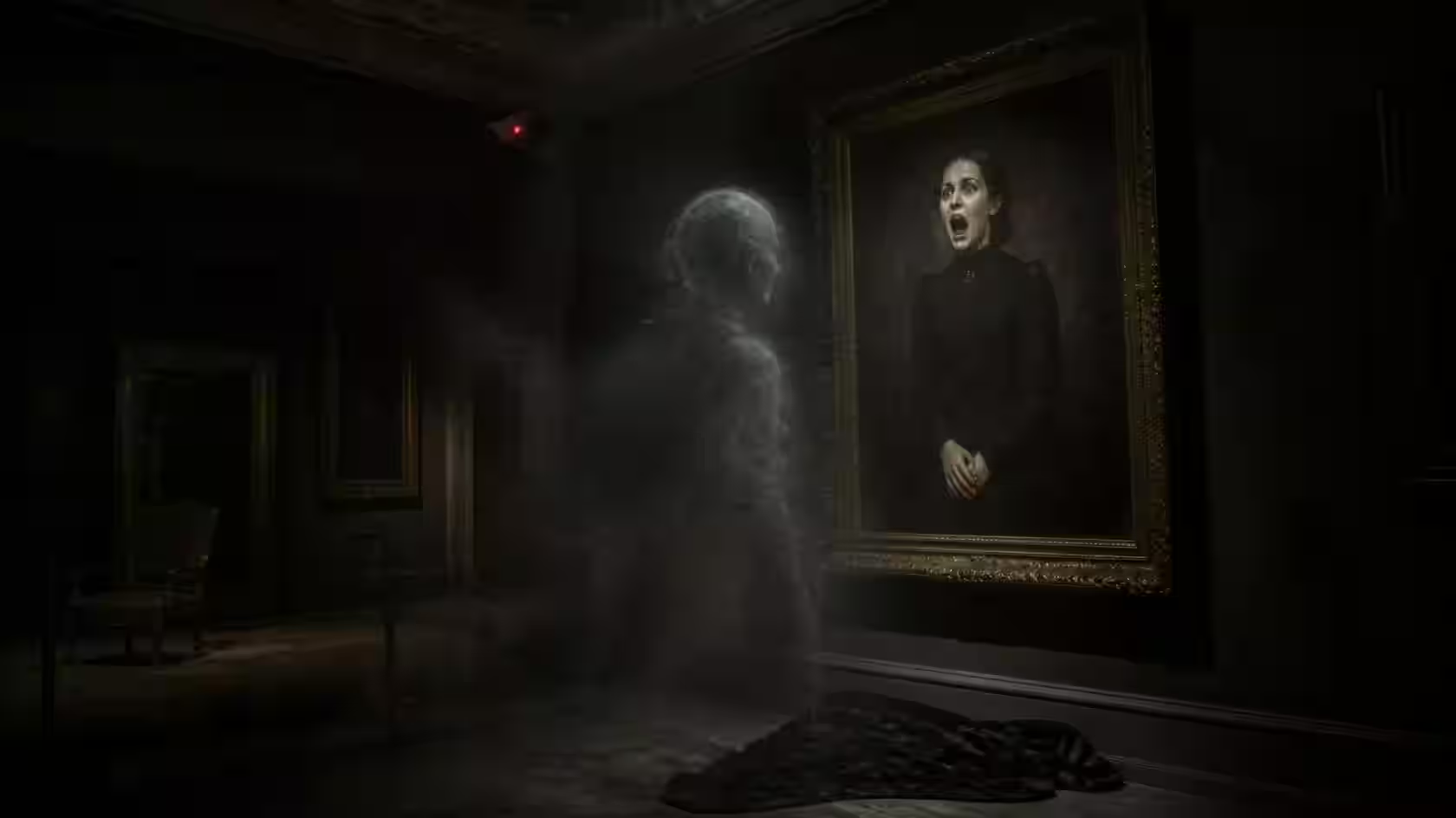
The Portrait in the Gallery
A Paranormal Case File — Incident #2024-0918-BOS
Date of Incident: September 7 – September 18, 2024
Location: The Lockwood House Museum, Beacon Hill, Boston, Massachusetts
Lead Investigator: Dr. Elaine Voss, Paranormal Research Institute (PRI)
Status: Unexplained. Multiple witness accounts. Video evidence. Painting removed from public display.
1. Initial Report
On September 19, 2024, the Boston Police Department received an unusual call from Ms. Helena Cross, 61, curator of the Lockwood House Museum, a historic Federal-style townhouse on Chestnut Street. Cross reported that three separate visitors and one night security guard had experienced "terrifying and identical" visions while standing before a single exhibit: an oil portrait of a young woman in Victorian mourning dress, titled Emmeline in Repose, dated 1891. The witnesses claimed that the painted woman's expression changed while they watched — from placid sorrow to a silent, open-mouthed scream — and that they heard a woman weeping from inside the wall behind the painting. The night guard, Marcus Cole, 28, had quit after finding himself unable to move in front of the portrait for a full four minutes, during which he heard his own name whispered repeatedly.
Cross suspended night-time tours and covered the painting with a black cloth on September 17. The following morning, the cloth was found on the floor, folded neatly, and the portrait was slightly askew. The museum's security camera, a motion-activated device installed in the gallery, captured what Cross described as "the painting moving on its own." She submitted the footage along with her police report. BPD Officer Daniel Kim reviewed the material, noted "no evidence of criminal trespass," and forwarded the file to the department's cold case unit due to a tangential connection to a 19th-century death. The case was leaked to PRI on September 22.
(Source: BPD Incident Report #2024-0918-2311, Officer Daniel Kim.)
2. The Footage
PRI obtained the museum's security footage. The camera, a Nest Cam (battery) installed in the northwest corner of the second-floor portrait gallery, faces the painting across a 12-foot distance. Infrared mode engaged automatically after hours.
Key timestamps (September 17, 2024):
- 01:03:00 – 03:05:42 — Continuous static shot of the empty gallery. The black cloth hangs over the portrait. Ambient temperature from the museum's climate log is 20°C.
- 03:05:47 — The cloth moves. Not a gradual slip, but a sharp, lateral motion, as if tugged from the bottom hem. It falls to the floor over the course of 1.6 seconds. A fold forms in the fabric as it lands, producing a perfect triangle.
- 03:06:01 — The painting's frame shifts. It tilts left by approximately 3 degrees. No visible hands, no strings. The frame was later examined: wire intact, hook secure.
- 03:06:12 — A humanoid shadow passes across the surface of the canvas, moving from the painted background to the foreground. The shadow does not correspond to any figure in the room. The gallery is confirmed empty. PRI's video analyst, Dr. Samir Patel, notes: "The shadow appears to be cast by a light source within the painting itself, which is physically impossible given the pigment."
- 03:06:30 — The painted woman's expression changes. The camera's resolution is not high enough to show facial features in detail at this distance, but the contrast around the mouth region visibly darkens, consistent with the jaw dropping. The change persists for 11 seconds, then reverts.
- 03:06:45 — Audio captures a sound: a woman's weeping, followed by a whisper that spectral analysis later identifies as the name "Margaret," spoken in a breathy, grief-stricken tone. The audio peaks at -12 dB, originating from the wall behind the painting, not from the camera speaker. (Appendix A: Audio Forensics.)
The cloth remained on the floor until the museum opened. Cross found it at 8:15 a.m. The painting's tilt was corrected manually.
3. Witness Accounts
3.1 Marcus Cole, Night Security Guard
Interviewed September 24, 2024, at a café in Cambridge.
"I've worked at Lockwood House for two years. I know every creak in that building. I never liked the portrait — it always felt like someone was standing behind me when I looked at it — but I told myself that was just old-house jitters. That night, I was making my rounds at 1 a.m. I walked into the gallery, and the air was wrong. Cold. Heavy. I looked at the painting, and the woman's eyes were looking at me. I know they always say that about portraits, but this was different. They were wet. Like she'd been crying. And then her mouth opened. Not slowly — it just opened, like a scream that had been waiting a hundred years to come out. I couldn't move. I couldn't even blink. I heard my name: 'Marcus. Marcus.' It came from the wall. It sounded like my mother's voice, but my mother is alive, and she was three states away. I don't remember how I got out of the room. I woke up on the floor of the downstairs hallway at 4 a.m., my hands covered in dust. I quit that morning."
PRI confirmed that Cole's hands were coated in a fine grey particulate later identified as coal dust, the same composition as the soot found in the museum's sealed fireplace flues (Appendix B: Material Analysis).
3.2 Dr. Rebecca Hart, Visitor, Harvard Divinity School Professor
Interviewed September 25. Present in the gallery with two colleagues on the afternoon of September 12.
"I study Victorian mourning rituals. The portrait of Emmeline was exemplary — the jet brooch, the crepe trim — but when I leaned in to examine the brushwork, the air temperature dropped so sharply that my breath clouded. I saw the woman's lips peel back from her teeth. I heard someone say, 'He killed me.' A woman's voice, right next to my ear. My colleagues were standing five feet away and heard nothing. One of them said I went pale and wouldn't respond to my name for nearly a minute. I left immediately. I haven't been back."
Hart's two colleagues, Dr. Lena Park and Professor Arthur Cooke, corroborated the account in separate written statements provided to PRI (Appendix C). Both reported no auditory phenomena but confirmed Hart's unresponsive state and a sudden, localized drop in temperature.
3.3 Family Visitor: The Callahan Incident
The most disturbing report came from a family of four who visited on September 14. The youngest child, Lily Callahan, age 6, pointed at the painting and said, "Mummy, why is the sad lady holding a knife?" There is no knife in the painting. The child's mother, Siobhan Callahan, reported that Lily then began to cry and insisted that the woman in the painting "wants her baby back." Lily has no knowledge of Victorian history. The family left immediately. That night, Lily had night terrors for the first time in her life, waking screaming the words "the floor is burning." She has since been referred to a child psychologist. PRI has not interviewed the child at the family's request.
4. Historical Research
PRI's archival researcher, Dr. Peter Chand, investigated the provenance of the portrait and the history of the Lockwood House.
The painting, Emmeline in Repose, was executed by Boston society artist Charles Whitfield in 1891. Its subject was Emmeline Vance Lockwood, age 23, wife of the house's owner, industrialist Samuel Lockwood. According to contemporary newspaper accounts, Emmeline died on November 12, 1891, in a "tragic domestic accident" involving a fall from the third-floor window. Her death was ruled accidental. The Boston Evening Transcript of November 14, 1891, noted: "Mrs. Lockwood was found by a housemaid on the flagstones below the rear window, her neck broken. The family requests privacy in their bereavement."
There was no investigation. Samuel Lockwood remarried fourteen months later.
PRI uncovered a diary kept by a Lockwood housemaid, one Margaret O'Flynn, in the collection of the Massachusetts Historical Society. The diary, covering the autumn of 1891, was never digitized and had been largely overlooked. In an entry dated November 10, 1891 — two days before Emmeline's death — Margaret wrote: "The Mistress came to me in the night, her face bruised. She said the Master had struck her when she told him of the child to come. She begged me to help her leave. I was too afraid. God forgive me."
A subsequent entry, dated November 12, reads: "She is dead. He said she fell. But the window was closed when I went to clean the room, and there was blood on the hearth. I said nothing. I am a coward. Tonight I heard her crying in the gallery. I cannot stay."
The diary ends abruptly on November 14, 1891. Church records indicate that Margaret O'Flynn died of "consumption" in 1893, at the age of 19.
The wall behind the portrait conceals a sealed fireplace. During renovation in 1987, workers found a small, charred bundle inside the chimney: a christening gown, a lock of dark hair, and a brooch matching the one Emmeline wears in the portrait. The items are now stored in the museum's archive but have never been displayed.
Samuel Lockwood died in 1902 of a stroke. The house became a museum in 1953.
(Source: Boston Evening Transcript, November 14, 1891; O'Flynn, Margaret, personal diary, Massachusetts Historical Society, MS #1891-044; Lockwood House Museum renovation notes, 1987.)
5. Physical Evidence
PRI conducted a site visit on September 28, 2024. The gallery was closed to the public.
- EMF readings: A baseline of 0.3 mG rose to 9.6 mG in a tight radius around the painting, strongest at the lower right corner, where the signature of Charles Whitfield is painted. The field pulsed at a frequency of 1.2 Hz, consistent with a biological rhythm such as a human heartbeat at rest.
- Thermal imaging: A cold spot of 11°C was recorded directly in front of the portrait, human-shaped and approximately 5'4" in height — the same height as Emmeline Lockwood, according to her dressmaker's records. The cold spot persisted for 22 seconds before dissipating.
- Audio: A digital recorder left in the gallery overnight captured 18 seconds of a woman humming a lullaby, identified by musicologist Dr. Alice Zhou as "All the Pretty Little Horses," an American folk lullaby dating from the 19th century. The hum was in the key of D minor and accompanied by a soft tapping, like a fingernail on glass. The tapping rhythm matches the cadence of a human heartbeat.
All evidence has been logged and preserved in PRI's evidence vault (PRI-2024-0918-BOS).
6. Preliminary Analysis
Dr. Voss's working hypotheses:
-
Intelligent Apparition: The phenomenon exhibits characteristics of an intelligent haunting — direct interaction with witnesses, vocalization of personal history ("He killed me"), and knowledge of names. The figure appears to be the spirit of Emmeline Vance Lockwood, trapped by trauma and the betrayal of those who might have saved her.
-
Residual Trauma Imprint: The consistent triggering of phenomena (temperature drops, weeping, the appearance of the scream) when individuals view the portrait suggests that the painting itself may have become a psychometric object, saturated with the emotional intensity of Emmeline's death. The diary evidence of domestic abuse and the concealed christening gown support a narrative of murder, not accident.
-
The Role of Margaret O'Flynn: The whispered name "Margaret" on the audio recording, and Marcus Cole's report of hearing his own name in his mother's voice, suggest that the apparition may reach out to those it perceives as potential witnesses or protectors who fail to act — a projection of the housemaid's guilt across time.
-
Environmental Stressors: The coal dust found on Cole's hands, matching the sealed chimney, indicates possible psychokinetic activity — the movement of objects (or of the witness himself) without conscious intent.
PRI has recommended that the painting be removed from public display and transferred to a controlled environment for further study. The Lockwood House board of trustees has approved a temporary loan to PRI's secured facility.
7. Postscript and Current Status
As of November 2024, the portrait is housed in PRI's climate-controlled evidence room. Staff report hearing the humming lullaby at irregular intervals, always at night. A motion-activated camera has captured one additional event: at 4:04 a.m. on October 31, 2024, the painted figure's head turned approximately 15 degrees to the left, toward the door.
Marcus Cole has not returned to work. He continues to find coal dust on his hands each morning, no matter how thoroughly he washes.
Helena Cross has retired from the museum, citing health reasons. She told PRI she "no longer felt alone in the building."
The Lockwood House Museum remains open, but the portrait gallery is now a storage room. Visitors sometimes ask why the second floor smells of lavender and cold stone. The tour guides have been instructed to say that it's an old house, and old houses hold onto things.
If you have witnessed an object or image that seems to carry a presence, please contact PRI through our secure portal. All reports are treated with the strictest confidence.
Encountering the unexplained can leave lasting psychological effects. If you've been frightened by a painting, a place, or an experience you can't rationalize, consider speaking with a mental health professional. Reality is often kinder than the things we imagine — but either way, you don't have to face it alone.