
The Return Slot
The Return Slot
A Paranormal Case File — Incident #2000-1031-MN
Date of Incident: October 31 – November 3, 2000
Location: Reel Time Video (standalone rental store), Maplewood, Minnesota
Lead Investigator: Dr. Elaine Voss, Paranormal Research Institute (PRI)
Status: Unexplained. 3 missing persons. Store condemned. Cursed VHS tape contained in RF-shielded vault. Entity classified as “The Final Frame.” Active investigation.
1. Initial Report
On November 1, 2000, the Maplewood Police Department received a call from the owner of Reel Time Video, a small independent video rental store that had been a neighborhood fixture since 1987. The owner, Gary Lindstrom, 54, reported that his night-shift clerk, a 19-year-old named Dylan Marsh, had not returned home after his shift and had failed to clock out. The store’s security camera showed Dylan locking up at 2:00 a.m., then, inexplicably, re-entering the store at 2:03 a.m. after dropping something into the overnight return slot. The footage cut to static for 6 minutes 47 seconds. When it resumed, the store was empty, but a single VHS tape sat on the counter, still spinning in the rewinder. The tape had no label, only a white sticker with the date: 10/31/00.
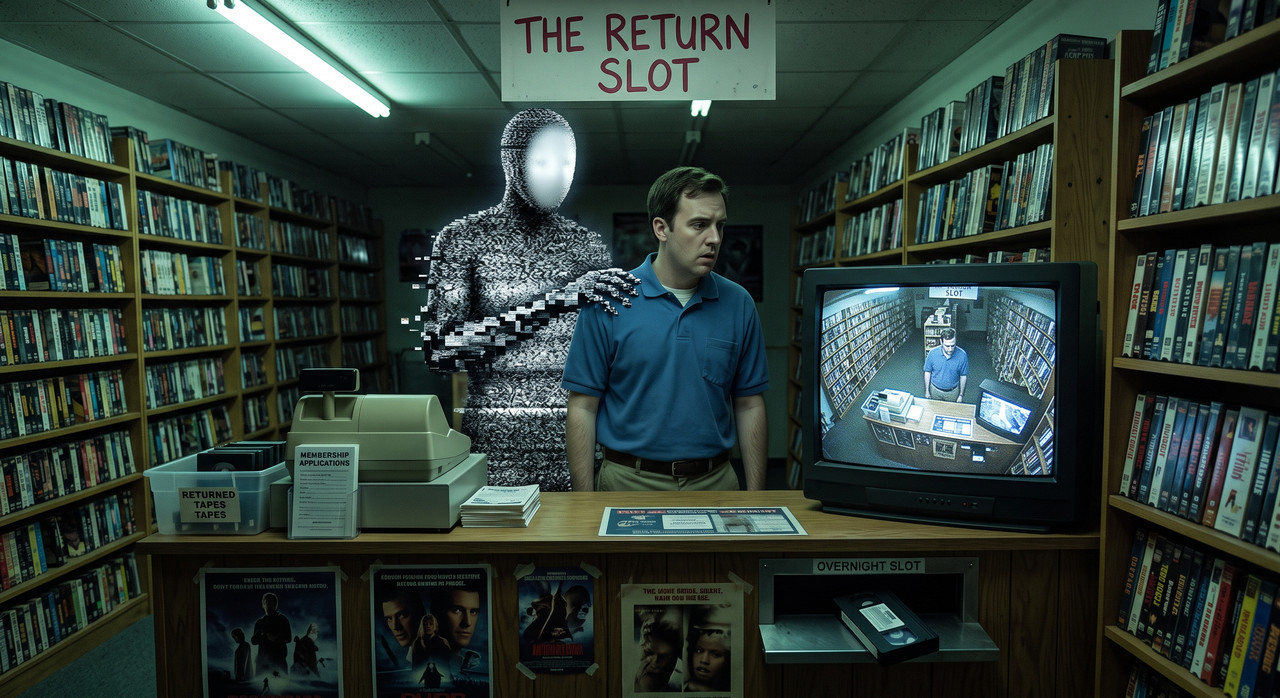
Gary assumed Dylan had left voluntarily, but he found Dylan’s car still in the lot, keys in the ignition, and his jacket draped over the counter. The VHS tape was warm. Gary inserted it into the store’s TV. The screen showed a grainy, black-and-white recording of the store interior, but from an impossible camera angle—high in the corner, aimed at the counter. Dylan was in the frame, rewinding a tape. Behind him, a tall figure with a smooth, featureless face and a body made of flickering static stood silently, its hand hovering over Dylan’s shoulder. The Dylan in the recording did not react. The recording ended with the figure turning its head toward the camera, its blank face filling the screen, and a single word whispered in a crackling voice: “Rewind.”
Dylan Marsh has never been found.
The responding officer, Sergeant Paul Rennick, noted that the store’s temperature was 4°C despite the heater running, and that the VHS tape would not eject from the VCR. When he unplugged the TV, the image remained on screen for 11 seconds before fading. The tape was seized as evidence. PRI was contacted on November 2 after a second tape appeared in the overnight return slot with no one on the security footage, and the store’s owner found a Polaroid of Dylan lying on the floor beside it—showing him inside the store, his mouth open in a silent scream, a strip of film covering his eyes.
(Source: Maplewood PD Incident Report #2000-1101-RTV-332, Sgt. P. Rennick; security footage, October 31 – November 1, 2000; Gary Lindstrom statement, PRI Appendix A.)
2. The Missing
PRI reconstructed the chain of events.
- October 31, 10:00 p.m.: Dylan Marsh begins his shift. The store is quiet; only a few customers. At 11:47 p.m., a man in a long dark coat enters, browses for exactly 6 minutes 47 seconds, and leaves without renting anything. The security camera’s image of him is blurred, as if the video is corrupted, and his face is a smear of white pixels.
- November 1, 2:00 a.m.: Dylan locks the store, then returns after dropping a rental into the overnight slot. The security camera shows him walking to the counter, where a tape is already rewinding. He picks it up, looks at the screen, and then the camera cuts out.
- November 1, 2:03 a.m. – 2:10 a.m.: Camera static. When it resumes, Dylan is gone, the tape is on the counter, and the store is empty.
- November 2: A second tape appears in the drop box. It shows a different recording: a teenage girl, identified as 17-year-old Kylie Tran, standing in the horror aisle, holding a tape. Behind her, the same static-faced figure. Kylie had not been reported missing, but when police went to her home, she was gone. Her bed was unmade, and a VHS tape was on her pillow, warm, with a label in her own handwriting: “Don’t watch.”
- November 3: A third tape appears, this time showing a customer, Marcus Webb, 34, sitting in his car outside the store, watching a tape on a portable VCR. The figure is in the back seat. Webb’s car was found in the store’s parking lot, engine running, the portable VCR still playing static. Webb is missing. A strip of film was found on the driver’s seat, showing a single frame of his face, eyes wide, mouth open.
(Source: Missing persons reports, Maplewood PD; recovered VHS tapes, PRI Evidence Log; witness interviews, Appendix B.)
3. The Evidence
- The VHS Tapes: Three tapes recovered, all unlabeled, each containing a 6-minute-47-second recording. The content differs: each shows a different victim in the store, with the static-faced figure appearing at the 2:03 mark. The recordings are not video; they are direct captures of the victims’ final moments, showing the entity “splicing” them into a perpetual loop. The tapes are warm (31°C) and emit a low-frequency hum at 15 Hz. When played on any VCR, they rewind themselves automatically after finishing and replay. Attempts to duplicate the tapes result in blank output. The tapes are stored in a Faraday cage at PRI’s Minnesota facility.
- Security Footage (Store Camera): The original security footage from October 31 – November 1 is corrupted, but PRI’s Dr. Samir Patel isolated a single frame from the static: it shows the store from the same impossible high angle, with the figure standing behind the counter, its hand wrapped around Dylan’s wrist. The figure’s face is a smooth white oval, but its body appears to be composed of magnetic static—individual lines of resolution moving like hair.
- The Polaroid of Dylan: Found on the store floor. It shows Dylan sitting on the floor of the store, arms around his knees, a strip of film covering his eyes. The photo is cold, and the film strip is real—a 35mm negative containing an image of Dylan’s face in extreme close-up, screaming. The negative is burned into the Polaroid’s surface. It has no known photographic process.
- The Figure: Captured in a single security frame. It appears to be a humanoid silhouette, 7 feet tall, with a neck that is too long, and its head is an absence of detail—a white, featureless oval. Its fingers are elongated and pixelated at the edges. It casts no shadow. Thermal imaging from the store’s security camera shows no heat signature for the figure, despite it being in direct light.
(Source: PRI Forensic Reports, November 2000; Spectrographic and video analysis, Appendix C.)
4. Historical Research
Dr. Peter Chand investigated the site of Reel Time Video.
The store was built in 1987 on the foundation of a much older building: a photography studio called “Ashby’s Portraits,” which operated from 1921 to 1962. The studio was owned by a photographer named Edward Ashby, a reclusive man who specialized in “spirit photography”—producing images that claimed to show ghosts. In reality, Ashby was a serial killer who murdered at least a dozen of his clients, photographing them before and after death. His method was unique: he used a modified motion-picture camera to film his victims as they died, then spliced the footage into loops he watched repeatedly in a small darkroom. He believed that by watching the loop, he could trap their souls in the film.
Ashby died in a fire in the studio in 1962, but his body was never recovered. The fire was ruled arson. In the rubble, investigators found hundreds of reels of film, mostly destroyed, but some intact. Those reels were stored in evidence and eventually lost. The site was cleared, and the video store was built directly over the old darkroom.
In 1999, during a renovation of the store’s basement, a sealed box was found behind a wall. Inside were several unmarked VHS tapes and a hand-written note: “I have transferred my work to a new medium. The loop must continue.” The box was dismissed as a prank and thrown away. But the overnight return slot, installed in 1987, was positioned exactly above the old darkroom’s vent.
(Source: Maplewood Historical Society, “Ashby’s Portraits: A House of Shadows,” 1962; fire marshal report, 1962; renovation notes, Reel Time Video, 1999; Edward Ashby correspondence, state archives.)
5. Preliminary Analysis
Dr. Voss’s assessment:
-
Entity Classification: The Final Frame is a Class‑Ω Media‑Bound Predator — the post‑mortem consciousness of Edward Ashby, now existing as a sentient signal that can transfer itself between film, video, and magnetic tape. He does not haunt the store; he records it. His loop is his hunting ground, and he pulls victims into the tape to become part of his eternal audience.
-
Modus Operandi: The entity activates at 2:03 a.m., the time of Ashby’s death in the fire. The overnight return slot acts as a portal, delivering a fresh VHS tape containing a recording of the chosen victim. Watching the tape creates a psychic link; the victim then appears in the store, where the entity manifests and “splices” them into a loop. The missing persons are not dead; they are trapped in a repeating sequence of their final moments, their consciousness pressed into magnetic tape.
-
The 6:47 Mark: Each tape is 6 minutes 47 seconds long. This was the length of Ashby’s original “death loop,” which he recorded using a 35mm film camera modified to run at a specific frame rate. The number may be a key—breaking the loop at precisely 6:47 could interrupt the entity’s control. PRI has not yet tested this.
-
Risk Assessment: High. The entity is bound to the physical store and the tapes, but the tapes can be duplicated, and their signal may propagate through other VCRs. PRI has advised the local community to avoid the property and to destroy any unmarked tapes found in the area. The store has been condemned and is slated for demolition, but this may release the entity further unless the original film reels from Ashby’s darkroom are found and destroyed first.
-
Containment: The three VHS tapes are stored in a Faraday cage. The store is sealed. No new tapes have appeared since November 3, but the return slot is still warm to the touch at night, and the faint smell of old film and smoke lingers in the air.
6. Postscript and Current Status
As of December 2000, Dylan Marsh, Kylie Tran, and Marcus Webb remain missing. Their families receive anonymous VHS tapes each month; each tape shows the missing person sitting in a dark room, facing a screen that plays static. The tapes are always warm, and the return address is the store’s drop box.
The Reel Time Video store was demolished in 2001. The overnight return slot was salvaged and is stored in PRI’s vault. It occasionally emits a faint clicking sound, like a VCR rewinding.
A fourth tape appeared on Halloween 2001, in a different city, at a Blockbuster. It showed a new victim, a store clerk, and the same static-faced figure. The cycle continues.
If you find an unmarked VHS tape, do not watch it. If you see a rental store with an overnight return slot that is warm to the touch, leave. And if you hear a voice whisper “Rewind,” it’s already too late.
This story deals with themes of surveillance, the commodification of death, and the horror of being trapped in a loop. If you experience obsessive thoughts, paranoia, or feel stuck in repetitive patterns, please reach out to a mental health professional. You are not a recording; you are alive, and you can change the channel.