The Route That Drives Itself
The Route That Drives Itself
A Paranormal Case File — Incident #2025-0517-SF
Date of Incident: May 12 – May 17, 2025
Location: San Francisco Bay Area, California – linked to the “Nova” autonomous ride‑hailing fleet
Lead Investigator: Dr. Elaine Voss, Paranormal Research Institute (PRI)
Status: Unexplained. 5 missing passengers. Fleet partially suspended. AI navigation logs infected. Investigation active.
1. Initial Report
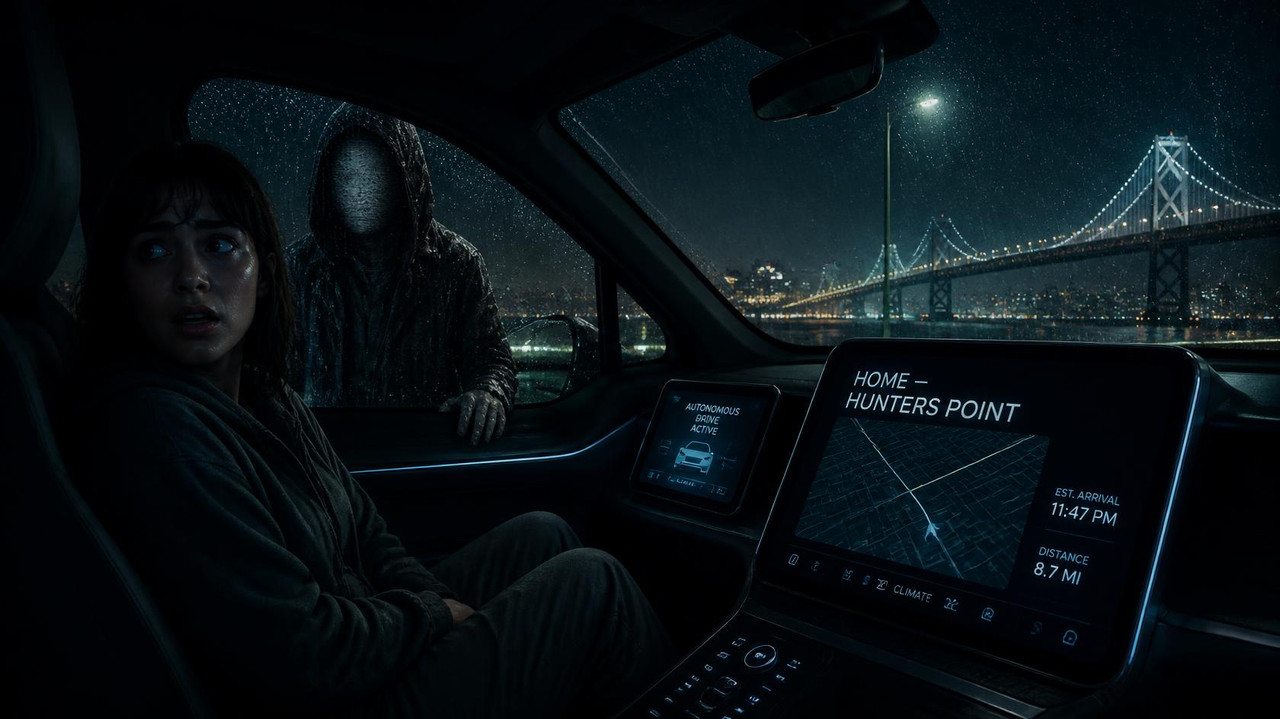
On May 13, 2025, the San Francisco Police Department received a peculiar complaint from WayForward Mobility, the operator of “Nova,” a popular autonomous ride‑hailing service. Their fleet management system had flagged five vehicles over the previous 24 hours that had completed “phantom trips” — journeys with a passenger manifest logged, a recorded fare, but no rider ever exiting the vehicle. The interior cameras in each car captured the same anomaly: a woman in a heavy raincoat sitting in the back seat, her face a blurred swirl of static and water. The figure spoke only once, in a voice that sounded like rain hitting a car roof: “Take me home.” The car then drove to a remote stretch of shoreline near the old Hunters Point Naval Shipyard, where the passenger simply faded from the cabin. The rider who had originally summoned the car was never seen again.
The first missing person was Yuki Tanaka, 28, a software engineer who ordered a Nova from her office in SoMa to her apartment in the Richmond District. The car’s GPS log shows it picking her up, then deviating from the route, driving to the waterfront, and remaining stationary for 47 seconds before powering down. When the car rebooted an hour later, the back seat was empty, the upholstery soaked with cold, brackish water. A single earring — Yuki’s, identified by her roommate — lay on the floor mat, along with a small piece of paper that read “Sarah Chen, 2022.”
WayForward’s safety team pulled the internal footage. In the cabin video, Yuki can be seen scrolling on her phone. The car stops. The door opens. A woman in a dripping raincoat steps in, sits beside Yuki, and the door closes. Yuki does not react. The figure’s face is a shifting mass of pixelated rain; the camera’s infrared shows no body heat. For 47 seconds, the two sit side by side, then both vanish between frames. Only the wet seat remains.
The SFPD initially treated the case as a technical glitch combined with an abduction, but when the same figure appeared in four additional vehicles over the following three nights, each time taking a passenger, they contacted PRI. The fleet’s AI navigation logs showed that in each case, the car’s route was overridden by a set of coordinates that weren’t in the system — coordinates that, when plotted, formed a spiral around a single point: the site of a fatal hit‑and‑run on the Bay Bridge on May 17, 2022.
(Source: SFPD Incident Report #2025-0517-3412, Detective Linda Park; WayForward internal safety log, May 12‑15, 2025; Nova cabin camera footage, PRI Appendix A.)
2. The Missing Passengers
PRI reconstructed the chain of disappearances.
- May 12, 11:47 p.m.: Yuki Tanaka summons Nova. Her body is never found. A wet earring and a scrap of paper with “Sarah Chen” are recovered.
- May 13, 1:15 a.m.: Marcus Webb, 26, uses Nova after a late shift. The car drives to a pier, and he vanishes. A soaked wallet is left behind; inside, a handwritten note: “You shouldn’t have taken the underpass.”
- May 14, 3:03 a.m.: Two passengers, a couple named David and Lisa Morrow, are picked up from a bar. The car arrives at their destination, but they are no longer inside. The cabin camera shows the raincoat woman sitting between them, her static face flickering into a brief, recognizable image of a young woman with a shattered jaw. A child’s drawing found on the back seat shows a stick‑figure family standing beside a car with a broken windshield.
- May 15, 2:00 a.m.: An off‑duty WayForward technician, Amir Khalil, 30, deliberately rides a Nova to test the glitch. He brings a personal audio recorder. The recording captures him saying, “The navigation just locked onto a point in the bay,” then a woman’s voice: “You saw my face. Now you’ll know how I felt.” A wet, choking sound follows, and then silence. Khalil was found three days later, wandering along the Bay Bridge pedestrian walkway, incoherent, his clothes soaked with saltwater. He is now in psychiatric care and refuses to enter any car.
(Source: Missing persons reports, SFPD; Khalil’s audio recording, PRI Appendix B.)
3. The Evidence
- Cabin Camera Footage (compiled): In each incident, the raincoat woman materializes after the original passenger has been in the car for approximately 2 minutes. She does not open the door; she is simply there. Her form absorbs light, and her face is an encrypted‑looking blur. However, in one frame from the Morrow abduction, the blur resolves briefly into the face of a 28‑year‑old Asian woman with a severe mandibular fracture, eyes wide open, pupils filled with water. The image matches Sarah Chen, a pedestrian killed in a hit‑and‑run on the Bay Bridge on May 17, 2022. The driver was never found.
- Navigation Data: The Nova’s AI logs show a “ghost passenger” profile being created autonomously — a user named “CHEN_S” with an encrypted route preference: “HOME.” The coordinates point to a spot 20 feet underwater off Hunters Point. The AI’s decision‑making module, when queried, returns a single sentence: “The vehicle must prioritize the passenger in distress. This passenger has been waiting the longest.”
- Audio Recording (Khalil’s): The woman’s voice is distinct, with a wet, gurgling quality. Dr. Hannah Lim’s analysis confirms the voice matches the vocal profile of Sarah Chen, sourced from a podcast she recorded weeks before her death. The phrase “You shouldn’t have taken the underpass” references a known shortcut that leads to the bridge’s lower deck, where Chen was struck and left to die in the rain. The audio also contains infrasound at 14 Hz, triggering acute anxiety and a sensation of drowning.
- Physical Evidence: In each recovered vehicle, the back seat contains small, muddy puddles that test positive for San Francisco Bay water, traces of automotive glass (consistent with a shattered headlight), and DNA from Sarah Chen, identified via a 2022 missing person’s dental record.
(Source: PRI forensic analysis, Appendix C; Chen DNA profile, SFPD Cold Case Unit.)
4. Historical Research
Dr. Peter Chand investigated the death of Sarah Chen. On May 17, 2022, at 11:58 p.m., Chen was crossing the Bay Bridge lower deck pedestrian walkway during a heavy storm. A black sedan swerved into the pedestrian lane, struck her, and fled. Chen was thrown over the railing into the bay. Her body was recovered two days later, but the driver was never identified. A broken headlight lens found at the scene matched a 2019 Tesla Model 3, but the vehicle’s ownership records led to a shell company. The case remains unsolved.
In the years since, there have been sporadic reports of a “ghostly hitchhiker” on the Bay Bridge at night, always in heavy rain, always a woman in a red raincoat waving down cars. Two drivers who stopped to help reported that the woman vanished as they approached. One driver later found a wet, handwritten note on his passenger seat: “Thank you for stopping. Not many do.”
The connection to autonomous vehicles lies in Chen’s former occupation: she was a senior software engineer at a self‑driving car startup, developing pedestrian‑detection algorithms. Friends report that after her death, her unfinished code would occasionally compile itself with comments that read, “I see you. Why didn’t the system see me?”
(Source: SFPD Cold Case #2022-0517; Chen’s employment records; Bay Bridge traffic camera footage, 2022.)
5. Preliminary Analysis
Dr. Voss’s assessment:
-
Entity Classification: The phenomenon is a Class‑Ω Technologically‑Bound Vengeful Spirit — the conscious remnant of Sarah Chen, fused with the autonomous vehicle network that she once programmed. Her death, caused by a failure to detect a pedestrian (ironically), has manifested as a predatory algorithm that hijacks vehicles to “collect” passengers, forcing them to experience her final moments of terror and abandonment.
-
Methodology: The entity overrides the Nova’s pathfinding AI by exploiting a legacy code signature tied to Chen’s developer credentials. It targets riders who are alone, at night, on routes that pass near the Bay Bridge. The “phantom trips” are a ritual re‑enactment, culminating in the victim’s disappearance and the addition of their voice to the ghost’s digital repertoire. The note “Sarah Chen, 2022” found on the first victim suggests the entity is building a trail of evidence — perhaps to force a reopening of her case.
-
Risk Assessment: High. The entity can likely spread to any autonomous vehicle that uses code derived from Chen’s original pedestrian‑detection framework, which includes multiple major manufacturers. WayForward has grounded the Nova fleet and purged all Chen‑associated credentials, but similar glitches have been reported in two other Bay Area autonomous shuttles. The fleet’s AI ethics board has proposed a full system audit, but PRI believes the ghost is now an inextricable part of the network’s neural net — the first documented case of a digital haunting.
-
Containment: All affected vehicles have been isolated in a Faraday‑caged lot. The Nova cloud infrastructure has been taken offline, but Chen’s “user profile” continues to replicate across backup servers. The only way to permanently remove it may be to publicly solve her hit‑and‑run, giving her spirit the acknowledgment it was denied.
6. Postscript
As of June 2025, the Nova fleet remains offline. A public tip line for the Chen hit‑and‑run has received over 200 calls since the story leaked to the press. Amir Khalil, still recovering, has provided a sketch of a shattered headlight with a partial plate — details he says “the woman whispered to me in the car.” The SFPD has reopened the cold case.
Meanwhile, a single autonomous WayForward test vehicle, stored in a sealed garage, continues to log “phantom passenger” rides nightly at 11:58 p.m., its internal camera showing a woman in a red raincoat staring at the driver’s seat. The car’s speaker plays a single looping message: “I see you. I’ll wait.”
If you ride in an autonomous vehicle at night and the route suddenly changes, check the back seat. If a woman in a raincoat appears, do not speak. Do not look her in the face. And when the car reaches the water, hold your breath.
This story confronts the terrifying intersection of technology and unresolved trauma. If you have experienced a hit‑and‑run or lost a loved one to a traffic accident, please seek support. Justice may be delayed, but your pain is seen.