
The Sea Glass
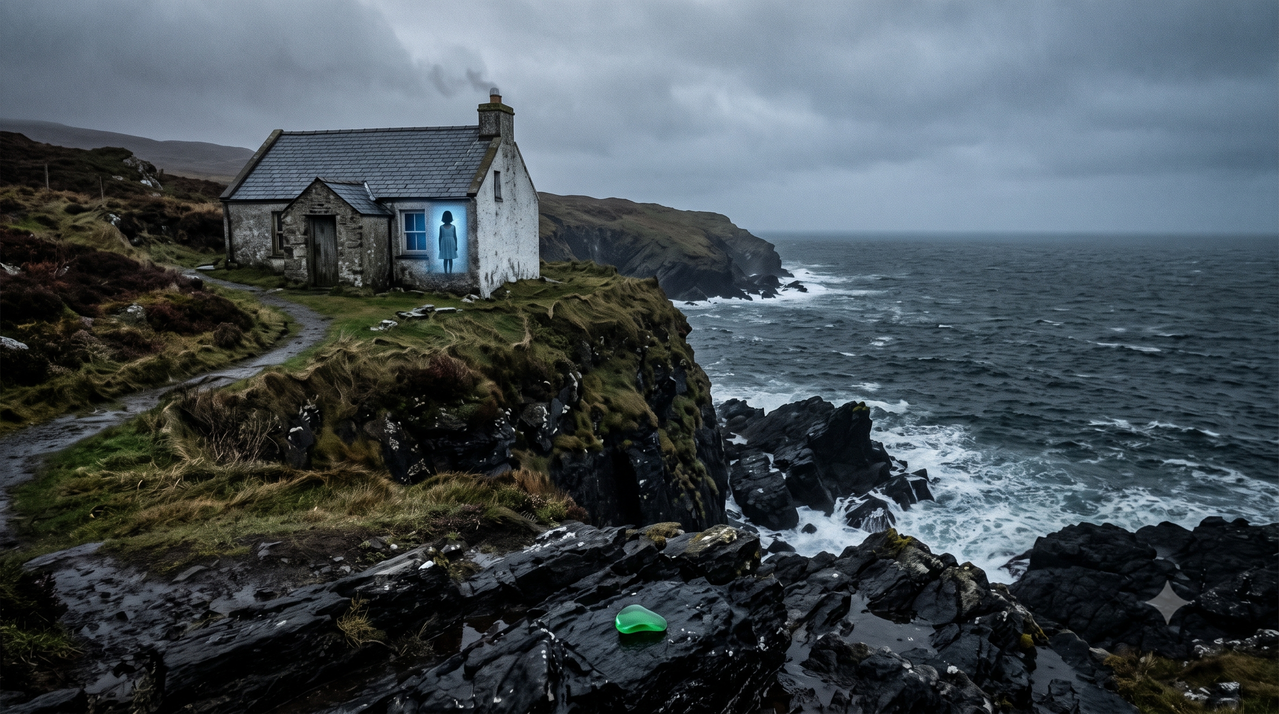
The Sea Glass
The house had been her grandmother's, and now it was hers, and Clara could not decide if that was a gift or a sentence.
Saltwick Cottage stood on a cliff above a grey North Sea that never stopped hissing. Its windows were small and deep-set, its roof sagged like an old horse's back, and inside it smelled of cold ash and the lavender sachets her grandmother had sewn into every drawer. Clara arrived in late October with a single suitcase and a quiet, familiar dread she had been carrying since she was nine years old. She was twenty-six now. The dread was seventeen years old and had not weakened.
She was there to clear the house. Her grandmother had died in August, peacefully, in her sleep, a phrase everyone used as if it made the absence smaller. Clara's mother had wanted to hire a clearance service. "It'll be too much for you, love. That place is full of—well, you know." Clara had said she needed to do it herself. She didn't explain why. She didn't say that she owed the house something. She didn't say that the house had been waiting.
The first night, she heard the door.
It was a small door, set into the wall of the upstairs landing, no taller than her shoulder. It led to a crawl space under the eaves where her grandmother had stored old trunks, Christmas decorations, the detritus of a long life. Clara had noticed it when she arrived, its brass handle tarnished green, its wood swollen shut. She had not tried to open it. But at half past two in the morning, she woke to the sound of it opening. A slow, sticky creak, then a soft click as it settled against the frame. She lay in her grandmother's bed, rigid, listening. The sea boomed against the cliffs. The wind worried the windowpanes. And from the landing, a small voice said, "Clara. You came back."
Clara pulled the quilt over her head like a child and did not lower it until the room was grey with dawn.
The voice was Beth's. She knew it instantly, the way you know a song you haven't heard since childhood—the bright, high pitch of it, the slight lisp on the "s" that made everything she said sound like a secret. Beth, who had been Clara's best friend from the age of six until the summer they both turned nine. Beth, who had lived two cottages down the cliff path. Beth, who had drowned in the cove below Saltwick Cottage on a still July afternoon while Clara stood frozen on the rocks, one hand outstretched, too terrified to jump in after her.
That was the story Clara had told the inquest. That was the story she had told her parents, the police, Beth's mother. It was mostly true. The part she left out—the part she had never spoken aloud—was the push. Not a shove with intent, just a moment of childish frustration, a hand against a shoulder blade during an argument over a piece of sea glass, Beth's foot slipping on the wet rock, the splash, the silence. A single second that had divided her life into before and after.
She had never told anyone. Not her grandmother, who had held her that night while she shook and said nothing. Not the therapist her parents sent her to. Not the man she had almost married and then left because she couldn't bear to be known. She had carried the truth like a stone in her chest, and now, it seemed, the stone had grown a voice.
The second day, she avoided the landing. She cleaned the kitchen instead, throwing away tins of soup that had expired in 2011, scrubbing the stove until her fingers ached. The mindless work was a mercy. She did not think about Beth. She did not think about the door. At dusk, she called her mother.
"How's it going up there? Are you sleeping?"
"Fine," Clara said. "The house is in good shape. It's just... stuff. Boxes."
"You don't sound fine."
Clara looked at the ceiling. Somewhere above her, the landing waited. "I'm just tired. It's a lot of memories."
"Your grandmother loved that house. She always said she'd never leave. I suppose, in a way, she didn't." Her mother laughed, a small, uncertain sound. "Funny, isn't it? How places hold onto people."
Clara closed her eyes. She almost said it: There's a door that opens by itself. I heard Beth's voice. She was asking for me. Instead, she said, "I'll be done by Sunday. I love you." She hung up and pressed her forehead against the cold kitchen wall.
That night, the voice came closer.
She had barricaded the bedroom door with a chair, a pointless gesture she was embarrassed by even as she did it. She lay in the dark, watching the strip of light beneath the door, waiting. At half past two, the crawl space door creaked open. Footsteps crossed the landing—small, bare feet on old floorboards. They stopped outside the bedroom. The chair did not matter. A shadow broke the light under the door: two small feet, the hem of a summer dress. The handle turned. The door did not open, but the wood breathed, as if something were pressing against it from the other side.
"Clara." Beth's voice, soft and patient, exactly as it had been in life. "I found the sea glass. The green one. It's still here. Do you want to see it?"
Clara bit down on her pillow and made no sound. She did not answer. But she wanted to. The wanting terrified her more than the voice.
On the third day, she opened the crawl space door.
It was daylight, and the sun was sharp through the landing window, and she told herself that light made things safe. The door swung outward with a groan. The space beyond was low and dark and thick with dust. She crouched and crawled inside, her phone torch cutting a weak beam through the murk. There were trunks. Boxes of mildewed books. A dress form draped in yellowed sheets. And in the far corner, a small wooden chest, painted with peeling daisies, the same chest Beth had kept at the foot of her bed.
Clara's hands trembled as she lifted the lid. Inside: a collection of sea glass, sorted by colour—brown, white, blue, and a single piece of green, smooth as silk, shaped like a tear. Beth had found it that day, the day she died. They had argued over it. Clara had wanted it. Beth had laughed and held it above her head, dancing along the rocks. You can't catch me. You're too slow. Clara had chased her. Her hand had found Beth's back. The rest was water.
She held the green sea glass in her palm. It was cold. It was real. She slipped it into her pocket and backed out of the crawl space, closing the door behind her. She did not put it down for the rest of the day.
That evening, she walked down the cliff path to the cove. The tide was out, the rocks bare and black and slick with weed. She stood where she had stood seventeen years ago, the sea glass heavy in her pocket, and for the first time since the funeral, she spoke the truth aloud.
"I pushed you."
The words were small. The sea took them.
"I didn't mean to. I was jealous. I was nine. But I pushed you, and you fell, and I didn't jump in. I just watched. I'm so sorry, Beth. I've been sorry every day."
Nothing happened. The waves kept breaking. The gulls kept crying. Clara stood until her feet went numb, then climbed back up the cliff in the dark, feeling emptier than she had ever felt.
She had hoped the house would be quieter. It wasn't.
That night, the footsteps did not stop at the door. She woke to find the chair she had propped against it set neatly aside, the door open, and a small figure standing at the foot of the bed. Beth looked exactly as she had on the last day of her life—sun-browned arms, a blue sundress, hair escaping from a crooked ponytail. Her eyes were the colour of the sea glass. She was smiling.
"You kept it," she said. "The green one."
Clara could not speak. She could only nod.
"I've been waiting," Beth said. "I couldn't leave. You know that. You knew it when you came back." She took a step closer. The air around her was cold, and it smelled of salt and wet stone. "Do you want to know what it's like? Being down there? All that time, in the dark, in the cold, and you just—went home. Had a birthday party. Grew up. Fell in love. While I stayed nine."
Clara was crying now, silent tears sliding into her mouth. "I'm sorry. I'm so sorry."
"I know," Beth said. Her smile didn't change. It was still the smile of a nine-year-old, innocent and cruel. "But sorry doesn't bring me back. Sorry doesn't warm the water." She reached out a hand. Her fingers were pale and wrinkled, as if they had been soaking for a very long time. "Come with me. Just down to the cove. Just for a little while. Then we'll be even."
Clara looked at that hand. She thought of the cold sea. She thought of the silence at the bottom. For one long, horrible moment, she wanted to take it. It would be so easy. It would be fair.
But she didn't. She closed her eyes. When she opened them, the room was empty. The chair was still beside the door. The sea glass was still in her pocket, but it was warm now, as if it had been held against someone's skin.
She left the next morning. She did not finish clearing the house. She packed her suitcase, locked the door behind her, and drove south without looking back. She told her mother the house was too much. She did not mention Beth. She told herself that leaving would end it.
It didn't.
Two weeks later, a young couple bought Saltwick Cottage as a holiday home. They loved the cliff views and the original features and the low price that seemed too good to be true. On their first night, the wife woke to the sound of a door opening somewhere upstairs. She nudged her husband. He mumbled and rolled over. She got up, walked to the landing, and saw the little door under the eaves, ajar. From inside, a child's voice said, "Hello. Do you want to play?"
She slammed the door and locked it. In the morning, she found a piece of green sea glass on the pillow beside her. She didn't know where it had come from. She never did find out.
Some ghosts aren't born from anger. Some are born from unfinished goodbyes. If the weight of old guilt or grief feels too heavy to carry alone, please reach out to someone who can help lighten it. You are not what happened. You are still here, and that matters.
Stay tuned to GHASTLYPAGES to read and listen to more such scary and terrifying stories.