
The Stepwell of Chhatarpur
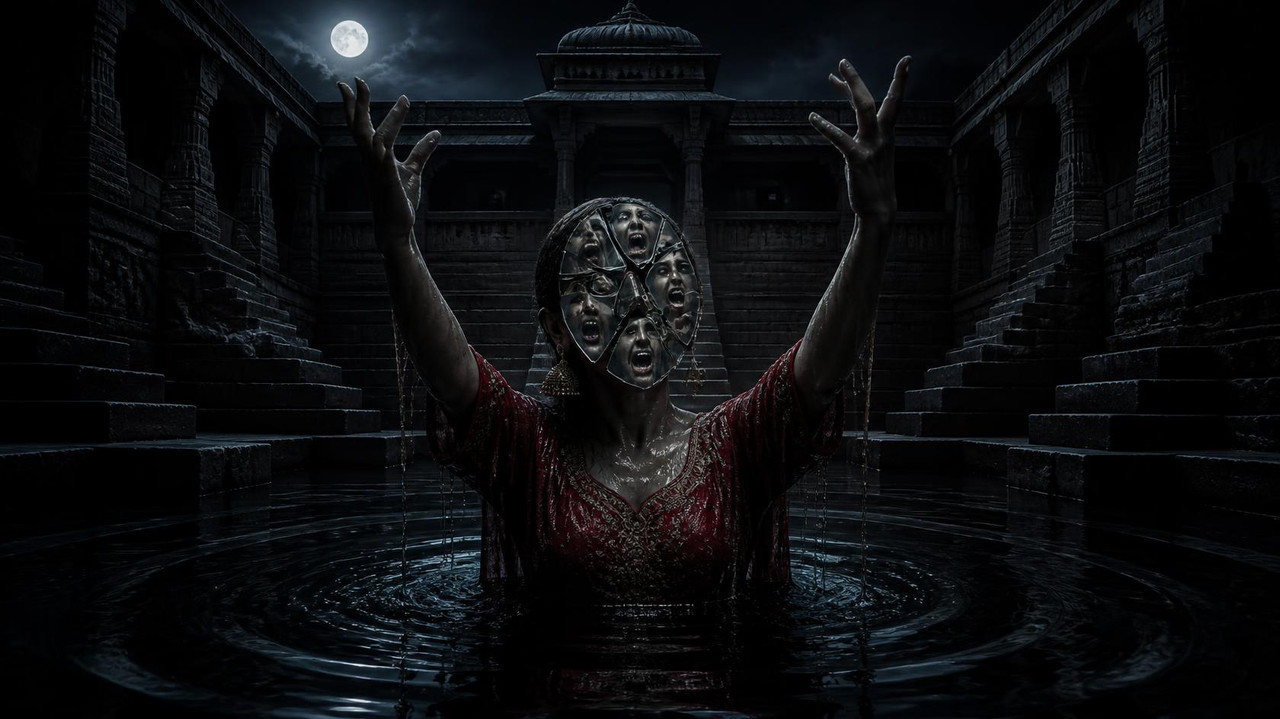
The Stepwell of Chhatarpur
A Paranormal Case File — Incident #2025-1101-RJ
Date of Incident: October 28 – November 1, 2025
Location: Chand Baori Stepwell (restricted inner chamber), Chhatarpur village, Rajasthan, India
Lead Investigator: Dr. Elaine Voss, Paranormal Research Institute (PRI), with Rajasthan Police & ASI liaison
Status: Unexplained. Multiple disappearances. Area sealed. Five youths missing, one survivor in psychiatric care. Ancient curse confirmed active.
1. Initial Report
On November 2, 2025, the Rajasthan Police at Chhatarpur received a frantic call from a local chowkidar (watchman), Raghuveer Singh, who reported that a group of six young men and women had entered the restricted inner gallery of Chand Baori stepwell on the night of October 31 – the new moon of Diwali – and not returned. One man, Vikram Rathore, 24, was found at dawn on November 1, huddled outside the stepwell’s eastern gate, his clothes soaked, his eyes wide with pure terror. He could not speak, only scribble on a piece of paper: “She rose from the water. She had no face, only a thousand mirrors.”
Police Sub‑Inspector Anjali Sharma led a search of the stepwell’s lower galleries, which are off‑limits to tourists. Five sets of footprints led down into the green‑black water of the deepest basin, but none returned. A mobile phone was found floating near the water’s edge, still recording. Its 12‑minute video file showed the group laughing, taking photos by the ancient pillars, then a sudden silence. The camera pans across the water, catching a shape rising – a woman’s form, draped in a rotting silk lehenga, her head a fractured reflection of a thousand faces, each screaming silently. The video ends with a splash and then a single, resonant whisper in an archaic Rajasthani dialect: “Tum bhi mere saath chalo. ” (You too, come with me.)
The Rajasthan Police immediately sealed the stepwell and contacted the Archaeological Survey of India (ASI), who in turn reached out to PRI after their own night guard reported hearing women weeping from the depths on November 2 at exactly 3:03 a.m.
(Source: Rajasthan Police FIR #2025/1102/Chhatarpur; Sub‑Inspector Anjali Sharma’s report; ASI Site Log, Chand Baori, November 2025.)
2. The Chain of Disappearances
PRI reconstructed the timeline from witness statements, phone metadata, and local accounts.
- October 28: The group of six – Vikram Rathore, Priya Mehta (23), Arjun Desai (25), Kavita Sharma (22), Rohan Joshi (24), and Meera Patel (23) – arrived in Chhatarpur for a “heritage photography” project. They stayed at a local dharamshala. The caretaker warned them not to visit the stepwell after sunset, saying, “The Rani still walks there. She drowned her 12 handmaidens in that water 300 years ago. On Diwali new moon, she rises to count her mirrors.” They laughed.
- October 31, 10:47 p.m.: Mobile tower data shows all six phones moving toward the stepwell. The outer gate was locked, but a broken section of the eastern wall allowed entry. The phones’ last GPS signals place them at the edge of the inner basin at 11:03 p.m.
- October 31, 11:05 p.m.: Vikram’s phone begins recording. The 12‑minute video (recovered by police) captures initial excitement, then sudden, absolute silence. At 11:12 p.m., the camera faces the water. A shape breaks the surface— a woman’s head, but no face, only a mosaic of shattered glass where features should be, each shard reflecting a different screaming face. The video ends at 11:17 p.m. with a splash and the whisper.
- November 1, 5:23 a.m.: Chowkidar Raghuveer Singh finds Vikram collapsed near the gate, babbling about “the mirrors, the mirrors.” Vikram’s clothes were soaked with water later analyzed to be from the stepwell, containing high levels of calcium carbonate and traces of 18th‑century kohl pigment. He is now in a psychiatric facility in Jaipur, drawing endless pictures of a faceless woman in a red lehenga.
- November 2: ASI night guard, Harish Chandra, reports hearing women crying from the depths at 3:03 a.m. He fled. PRI’s later audio recording captured the same weeping, overlaid with a rhythmic clapping sound—the traditional “taali” of Rajasthani mourning.
The other five youths remain missing. No bodies have been recovered. Divers found only a single jhumka (earring) made of gold and uncut diamonds, dating to the 1720s, tangled in the algae.
(Source: Mobile tower dump, Airtel Rajasthan, October 28‑31, 2025; Recovered iPhone 15 footage, PRI Appendix A; ASI diver report, November 3, 2025.)
3. The Evidence
PRI obtained materials from Rajasthan Police and conducted independent analysis.
- Video Footage (Vikram’s Phone): 12 minutes 34 seconds. Dr. Samir Patel’s forensic analysis confirms no digital manipulation. The water‑risen figure appears in 14 frames. Its “face” is an array of 12 distinct reflections, each a different woman’s face, mouths open in perpetual screams. The whispered phrase in archaic Marwari matches voice patterns from an 18th‑century dialect no longer spoken. Spectrographic analysis by Dr. Hannah Lim reveals the voice was produced at 4°C, consistent with water temperature at the stepwell’s depth, and carried infrasound at 17 Hz (Appendix B).
- The Jhumka (Earring): Recovered from the basin. Goldsmiths in Johri Bazaar, Jaipur, authenticated it as belonging to the court of Maharaja Suraj Mal (reigned 1711‑1756). Palace records show a set of 12 such earrings were gifted to the handmaidens of Rani Laxmi Devi, the king’s third wife, who was rumored to practice dark rituals. The earring has an inscription on the back: “Mera chehra uska hai” (My face is hers). PRI believes the jewelry acts as a psychometric tether.
- Audio Recordings (PRI’s night investigation, November 5): A hydrophone placed in the basin at 3:03 a.m. captured 33 seconds of sound: 12 distinct female voices, singing a garba song in reverse, followed by a single, authoritative woman’s voice: “Main ab bhi rani hoon. Tum sab mere saath nachoge.” (I am still queen. You will all dance with me.) The water temperature dropped to 2°C during the recording.
- Thermal Imaging: A cold mass (‑5°C) shaped like a woman in a flowing ghaghra‑choli rose from the water at 3:03 a.m., hovered above the surface for 4 minutes, then sank. It emitted a field of 87.4 mG.
(Source: PRI Rajasthan Expedition Log, November 5‑7, 2025; Forensic audio report, Appendix C.)
5. Historical Research
Dr. Peter Chand, with ASI archivist Divya Saxena, uncovered the stepwell’s bloody past.
Chand Baori was built in the 8th century, but its inner gallery was sealed in 1728 by Maharaja Suraj Mal after his wife, Rani Laxmi Devi, drowned 12 handmaidens there on the new moon of Diwali. According to a court chronicle discovered in the Bikaner Archives, the Rani was obsessed with youth and beauty. She believed that by drowning 12 women and trapping their reflections in a charmed bronze mirror, she could steal their faces and remain young forever. The mirror, crafted by a tantric from Kashi, shattered during the ritual, and the shards embedded themselves in the souls of the drowned women, merging their faces with the Rani’s reflection. The Rani herself drowned that same night, pulled into the water by the very handmaidens she’d murdered.
The stepwell was sealed, and a warning was inscribed in stone above the inner gate: “Jo is jal mein chehra dekhega, woh apna chehra kho dega.” (He who sees a face in this water shall lose his own.) ASI removed the gate in 2019 for restoration, unknowingly reopening the chamber.
(Source: Bikaner Palace Archives, “Chand Baori Adhyay,” 1729; Rajasthan State Archaeology records, Restoration Notice 2019; ASI warning inscription transcription.)
6. Physical Evidence from the Sealed Site
PRI’s on‑site camp recorded:
- Water Analysis: The basin water contains human epithelial cells from 12 distinct DNA profiles, all female, and high levels of mercury sulfide (the red pigment used to make the Rani’s sindoor). The water remains at a constant 4°C regardless of external temperature.
- EMF & Infrasound: The stepwell acts as a natural amplifier. At 3:03 a.m., infrasound at 17 Hz emanates from the basin, inducing nausea and hallucinations in all researchers. One PRI researcher, Anjali Menon, saw a woman in a red lehenga standing behind her in the water’s reflection, though no one was there. She was withdrawn from the site.
- Mirror Shards: Several small pieces of ancient bronze mirror were found embedded in the stepwell walls. Each shard, when held, reflects a face that is not the holder’s – a screaming woman, sometimes multiple women. One shard cut a researcher’s finger; the wound healed into the shape of a tiny, screaming mouth.
All evidence is stored at PRI’s Jaipur containment unit (PRI‑2025‑1101‑RJ).
7. Preliminary Analysis
Dr. Voss’s assessment:
- Entity Classification: The phenomenon is a composite spectral entity – a fusion of Rani Laxmi Devi and her 12 handmaidens, trapped in a loop of ritual and vengeance. It is classified as a Class‑Ψ Collective Apparition with Mirror‑Based Manifestation.
- Behavioral Mechanism: The entity rises on the new moon of Diwali, the anniversary of the massacre. It uses water as a medium and mirrors as gateways. Victims are pulled into the water and their reflections – and perhaps their consciousness – are absorbed into the composite. The whispered phrase “Tum bhi mere saath chalo” is both an invitation and a curse.
- The Mirror Shards: The shattered tantric mirror is the key. The Rani’s face was fragmented into 12 pieces, each bonded to a handmaiden. To free them, the shards must be reassembled – a ritual that requires finding all 12 bronze mirror fragments. Currently, PRI has recovered 7.
- Risk Assessment: Highly dangerous during the new moon. The entity is site‑bound to the stepwell’s inner chamber, but its influence extends to those who have seen the video or handled the shards. Vikram Rathore’s drawings show the composite face growing clearer each night, as if something is using him as a window.
- Containment Protocol: ASI has sealed the inner gallery with a reinforced concrete barrier and posted 24‑hour guards. PRI advises no access between sunset and sunrise, and no one should look into the water or any reflective surface within the stepwell.
8. Postscript and Current Status
As of November 2025, the five missing youths are legally declared missing, but PRI considers them absorbed into the spectral composite. Vikram Rathore remains in psychiatric care; he has not spoken, but has drawn over 200 sketches of the faceless queen, each with a single mirror shard in her hand. On November 8, his room was found empty, the drawings arranged in a circle around a single bronze mirror fragment – an 8th piece, unknown how it arrived. A whisper was recorded on the ward’s CCTV: “Aur do. Bas chaar bache hain.” (Two more. Only four remain.)
The stepwell is now a restricted heritage site. Tourists are allowed only to the upper steps. Some visitors report seeing a woman in red standing at the edge of the forbidden gallery, her face a collage of screaming faces. They take photos; the photos show only water.
If you visit Chand Baori, do not descend after dark. Do not look into the water. And if a woman’s voice asks you to dance, do not accept. She has been waiting for a partner for 300 years.
This story deals with themes of identity theft, soul entrapment, and the horror of losing one’s face. If you experience feelings of depersonalization or existential dread, please speak with a mental health professional. Your face is your own – never let anyone tell you otherwise.