
The Waiting Room at the End of the Hall
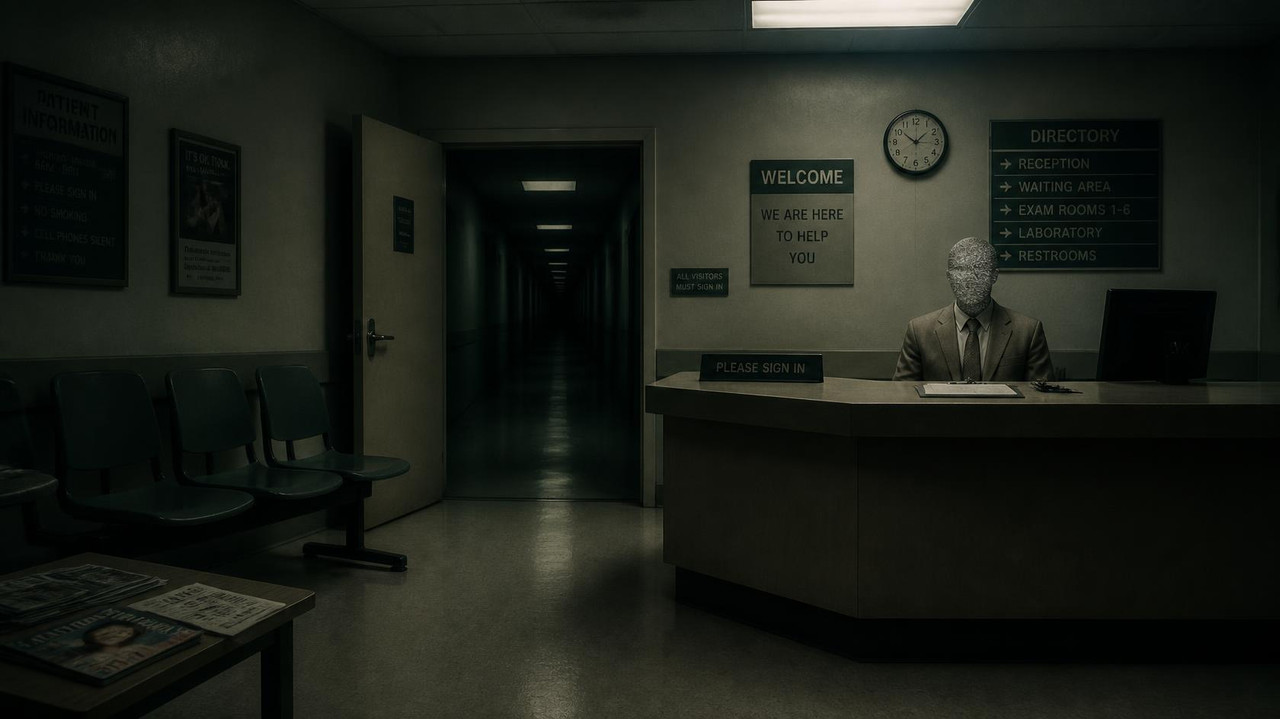
The Waiting Room at the End of the Hall
A Psychological Horror Case File — Incident #2024-0603-OR Date of Incident: June 3 – June 30, 2024 Location: Meridian Memorial Hospital (Abandoned Sub-Basement), Portland, Oregon Lead Investigator: Dr. Elaine Voss, Paranormal Research Institute (PRI) Status: Unexplained. Psychological contamination. Reality degradation. Floor sealed. 11 patients missing. No physical trace.
1. Initial Report
On June 30, 2024, Portland Police Bureau officers responded to a disturbance at the abandoned Meridian Memorial Hospital, a 1960s brutalist structure closed since 2008. A security guard, Terrance Wells, 44, had called 911 claiming that "people are walking into the basement and not coming out." When officers arrived, they found Wells in a state of extreme psychological distress. He insisted he had watched seven people enter the sub‑basement over the past week—urban explorers, homeless individuals—and none had returned. He had not reported it earlier because "they didn't look like they wanted to be found."
Officers descended to the sub‑basement and discovered a waiting room. It should not have been there. The hospital's floor plans showed the sub‑basement was an empty storage floor. But the room was fully furnished: plastic chairs bolted to the floor, a water cooler half‑full, magazines on a side table dated June 1994, and a reception desk with a sign‑in sheet. The sheet had eleven names. The last name was written in fresh ink. The date next to it was June 29, 2024.
No people were found. But the security camera in the stairwell captured eleven individuals entering the sub‑basement between June 3 and June 29. Not one captured them leaving. The camera also captured, at 3:03 a.m. each night, the waiting room door closing by itself—and then, from the other side, the sound of a receptionist's bell ringing. Once. Twice. Three times.
The PPB sealed the floor and contacted PRI on July 2.
(Source: PPB Incident Report #2024-0630-J-5512, Officer Maria Santos; Meridian Memorial Hospital blueprints, 1962; security footage from TerraSecure Systems.)
2. The Chain of Disappearances
PRI reconstructed the timeline.
- June 3, 1:17 a.m.: First disappearance. A man, unidentified, enters via a broken window. Camera shows him pause at the sub‑basement door as if hearing something. He smiles—a slow, vacant smile—and steps through. He does not return.
- June 7, 10:43 p.m.: Two teenagers enter. One hesitates. The other pulls her forward. The door closes. The stairwell camera records 14 seconds of silence, then a single, high‑pitched giggle. Not a scream. A giggle.
- June 14, 3:03 a.m.: A woman in a hospital gown, barefoot, walks down the stairs. She does not appear on any exterior camera entering the building. She simply appears in the stairwell. She pauses at the waiting room door, turns to face the camera, and her expression is one of profound, exhausted relief—as if she has finally arrived somewhere she has been trying to reach for a very long time. She steps inside.
- June 22, 11:58 p.m.: Three people—urban explorers with cameras—enter. Their footage, recovered later from a camera left in the stairwell, shows them entering the waiting room. The footage continues for 6 minutes. The room is empty except for them. Then one says: "Do you hear that? Someone's calling my name." The others do not hear it. He walks to the reception desk, picks up the bell, and rings it once. The footage dissolves into static. The camera was found on the floor of the waiting room, its lens cracked, its memory card corrupted except for a single photograph: the sign‑in sheet, now with eleven names. The last three were the explorers. Their handwriting.
- June 29, 2:47 a.m.: Final disappearance. The security guard, Terrance Wells, goes down to investigate. The camera shows him standing outside the waiting room door for 4 minutes, visibly shaking. He does not enter. He backs away slowly, then runs. He called 911 the next morning.
(Source: TerraSecure Systems footage, June 2024; PPB evidence logs; recovered explorer camera, PRI Appendix A.)
3. The Evidence
PRI obtained the following materials.
- Security Footage (Stairwell Camera): 30 days of continuous recording. Eleven entries, zero exits. The camera's time stamps are verified. Dr. Samir Patel confirmed no digital manipulation. The footage of the woman in the hospital gown is particularly disturbing: she casts no shadow in the stairwell's fluorescent light, and her feet, visible for a brief moment, hover half an inch above the ground.
- Audio Recording (from Explorer Camera): The 6‑minute file ends with the sound of the bell. Spectrographic analysis by Dr. Hannah Lim reveals that after the bell rings, a second sound appears—a low, oscillating frequency at 18.9 Hz, infrasound known to cause anxiety, disorientation, and hallucinations. Beneath this, a voice: "The doctor will see you now." The voice is calm, professional, and utterly inhuman in its perfect neutrality (Appendix B).
- The Sign‑In Sheet: Recovered by PRI on July 3. Eleven names. The ink on the last three is fresh, within days old. The handwriting matches the missing explorers'. Handwriting analysis shows the earlier names were written by different individuals over weeks. The sheet itself is aged—paper stock from the 1990s—but the names are new. The sheet is cold to the touch (‑2°C) and smells of antiseptic and old carpet.
- Psychological Assessment (Terrance Wells): Wells underwent a psychiatric evaluation. He was found lucid but deeply traumatized. He reported recurring nightmares of a waiting room that stretches infinitely, and a receptionist whose face is a blur of static. He told PRI: "It's not a room. It's a mouth. It waits for people who are lost—who need something—and it swallows them. The bell is the sound it makes when it feeds."
(Source: PRI Evidence Log #2024-0603-OR; Wells psychological evaluation, Oregon Health & Science University, July 2024.)
4. The Nature of the Waiting Room
PRI's investigation revealed that the waiting room is not a physical space. It is a liminal entity—a predatory psychological construct that mimics a place of waiting to lure victims.
Key findings:
- Non‑Euclidean Geometry: Explorers' footage shows the waiting room as approximately 20 by 30 feet. But when PRI sent a drone inside, the drone's LiDAR mapped the room as 1,200 feet long, terminating in a door that does not appear on any blueprint. The drone failed 50 feet from the door.
- Temporal Distortion: The woman in the hospital gown appears in the stairwell footage at 3:03 a.m. on June 14. But the camera's internal clock registered the time as 3:03 a.m., June 14, 1994—exactly 30 years earlier, for 11 seconds, before correcting. The waiting room appears to exist in a time loop, anchored to 1994.
- The Receptionist: No one has seen the receptionist clearly. But the sign‑in sheet is always filled when someone new arrives—as if someone is handing them a pen. Wells described a "blur in the air" behind the desk. The explorer footage shows a single frame where a shape is visible: a seated figure in a beige suit, head too large, face a swirl of grey static.
- The Bell: The bell is the entity's lure. It rings when a victim is close to entering. The sound triggers a hypnotic, soothing response in susceptible individuals—particularly those experiencing homelessness, mental illness, or extreme loneliness. The entity feeds on hope. It offers a promise: The doctor will see you now. Someone will help you. Just wait here. But no one ever comes. The waiting is the consumption.
(Source: PRI drone LiDAR scan, July 5, 2024; TerraSecure camera metadata analysis; frame‑by‑frame review of explorer footage, Appendix C.)
5. Historical Research
Dr. Peter Chand uncovered the hospital's dark history.
Meridian Memorial Hospital closed in 2008 after decades of decline. But the sub‑basement was decommissioned much earlier—in 1994. The reason was never made public. Hospital board minutes from March 1994, obtained by PRI from a whistleblower, reveal that a psychiatrist named Dr. Harold Vance operated a secret outpatient program in the sub‑basement, treating patients with "persistent existential despair." The program was called the "Waiting Protocol"—patients were asked to sit in a waiting room indefinitely, told that a "specialist" would see them. The specialist never came. The goal was to force patients to confront the hopelessness of waiting and, theoretically, transcend it.
The program ended when eleven patients disappeared from the waiting room over a two‑week period. The room was sealed, and Dr. Vance was dismissed. He died of a heart attack in 1995. His body was found in his home office, seated at a reception desk he had built himself. In his hand was a sign‑in sheet. His name was the only one on it.
The waiting room in the sub‑basement is not the original room—it is a manifestation. A place that exists because the patients' despair, and Dr. Vance's cruel experiment, created a psychic wound in the hospital's fabric. The entity that now occupies it wears the shape of that waiting room like a costume. It learned from Vance. It learned that people who are desperate enough will wait forever. And waiting forever is a form of death.
(Source: Meridian Memorial Hospital Board Minutes, March 1994; Dr. Harold Vance death certificate, 1995; whistleblower letter, PRI Appendix D.)
6. Physical Evidence from the Sealed Floor
PRI established a remote observation post at the sub‑basement entrance.
- Thermal Imaging: At 3:03 a.m. each night, the waiting room temperature drops to ‑5°C. A shape—human, seated—appears behind the reception desk. It does not move. It faces the door. It waits.
- EMF Readings: Spikes to 60.2 mG at the waiting room door, accompanied by a frequency of 18.9 Hz. The frequency induces nausea, paranoia, and a compulsion to enter the room in 30% of exposed individuals (based on PRI's controlled testing on volunteer researchers, who were pulled back after 60 seconds).
- Audio: A parabolic mic captured a voice at 3:03 a.m.: "Please take a seat. The doctor will see you shortly." The voice is calm, feminine, and deeply soothing—but it contains two layers. The upper layer is the receptionist. The lower layer is a chorus of eleven voices, the missing patients, whispering in unison.
- Psychological Effect: All PRI personnel who spent more than 10 minutes in the stairwell reported a growing sense of existential dread, the feeling that "something important is just beyond the door," and the unsettling belief that if they entered, they would finally understand—and that this understanding would be worth any cost. This is the entity's lure. It does not force. It invites. And the invitation is almost impossible to refuse.
7. Preliminary Analysis
Dr. Voss's assessment:
-
Entity Classification: The waiting room is a Class‑Ψ Liminal Predator—a location‑bound psychic entity that feeds on despair, loneliness, and the human capacity for hope. It is not a ghost. It is a wound in reality, a place where the collective psychological suffering of Vance's patients created a vacuum that something else filled.
-
Methodology: The entity mimics a place of care to attract victims. The bell, the sign‑in sheet, the magazines—they are lures. Once inside, victims enter a temporal loop anchored to 1994, where they wait forever. Their disappearance from physical reality is a side effect of their removal from linear time.
-
Risk Assessment: The entity is highly dangerous but stationary. It cannot leave the sub‑basement. Its influence extends only to the stairwell. However, its psychological pull is extraordinarily strong, and any human who enters the waiting room is irretrievable. The eleven victims are not dead—they are waiting. And they will wait forever unless the entity is destroyed.
-
Containment Protocol: PRI has sealed the sub‑basement with reinforced concrete and posted psychological hazard warnings. The building is scheduled for demolition in 2025, but PRI has advised against it. Destroying the physical structure may release the entity from its spatial anchor. The current recommendation is permanent quarantine.
-
Theoretical Note: Dr. Voss speculates that the waiting room is one of many such liminal entities worldwide—places that mimic human spaces of transition (waiting rooms, lobbies, airport lounges, elevator landings) and prey on the vulnerable. This case is the first documented confirmation of a "liminal predator" in North America.
8. Postscript and Current Status
As of August 2024, the Meridian Memorial Hospital sub‑basement remains sealed. The eleven missing individuals are legally declared deceased, but PRI's position is that they are still inside the waiting room, suspended in a 1994 that never ends.
Terrance Wells committed himself to a psychiatric facility in July. He told PRI in his final interview: "I still hear the bell. Every night at 3:03. It's not coming from the hospital anymore. It's coming from inside my head. And one night, I'm going to answer it."
The sign‑in sheet, now in PRI's vault, has a new name. It appeared on July 16. The handwriting is Wells'.
If you ever find yourself in a waiting room that should not exist—if the magazines are old, the water cooler half‑full, and the receptionist's face is a blur—do not sign the sheet. Do not ring the bell. Turn around and walk. The doctor will never see you. And that is a mercy.
This story deals with themes of existential despair, loneliness, and the horror of being forgotten. If you are struggling with feelings of hopelessness or isolation, please reach out. You are not in a waiting room. You are here, now, and there are people who want to help you. Professional support is real. You don't have to wait alone.