
The Whistling Anemometer
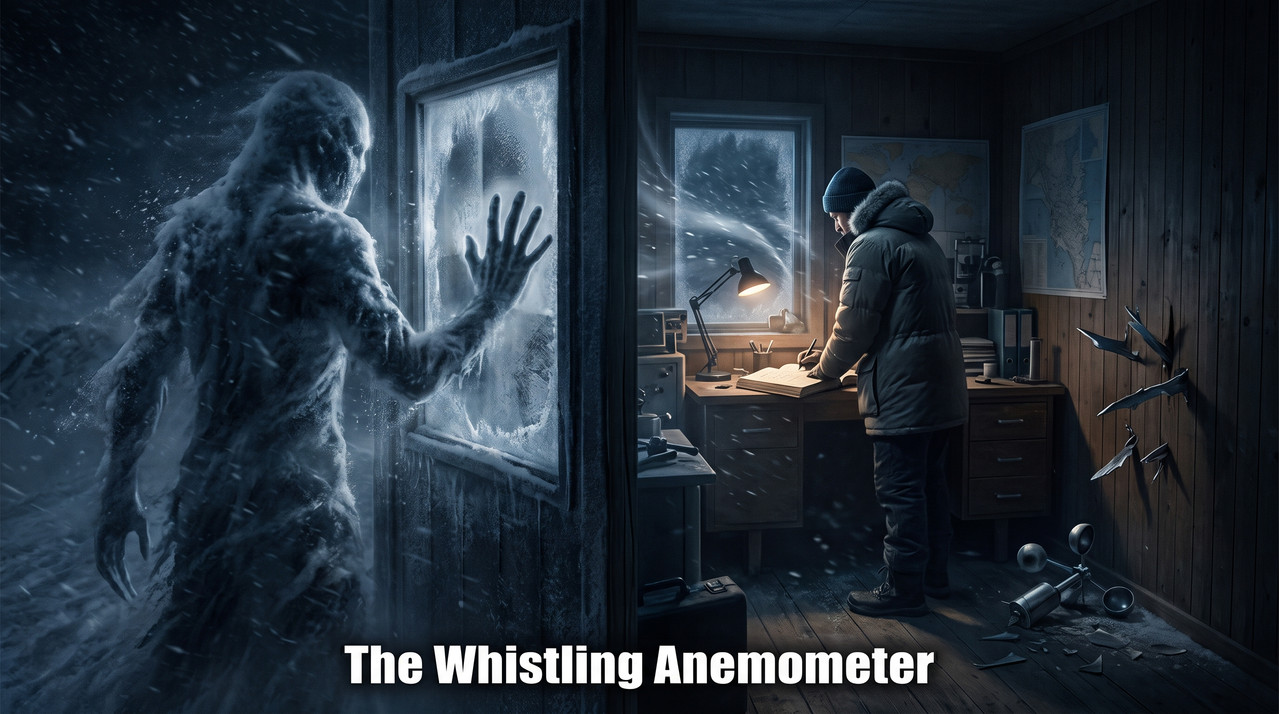
The Whistling Anemometer
A Paranormal Case File — Incident #2026-0214-WA
Date of Incident: February 10 – February 14, 2026
Location: Mount Storm Research Station (remote meteorological outpost), North Cascades, Washington
Lead Investigator: Dr. Elaine Voss, Paranormal Research Institute (PRI), with U.S. Forest Service liaison
Status: Unexplained. 1 confirmed missing person, 3 researchers hospitalized with frostbite and auditory trauma. Station quarantined. Entity classified as “The Wind Walker.” Investigation active.
1. Initial Report
On February 15, 2026, the Whatcom County Sheriff’s Office received an automated distress call from the Mount Storm Research Station, a seasonal meteorological outpost at 6,200 feet elevation, usually staffed by three researchers during winter months. The call was not a voice but a recorded loop of wind howling, punctuated by a rhythmic whistling that lasted exactly 47 seconds before cutting off. When rangers reached the station on February 16, they found the front door ajar, the interior temperature at −8°C despite the furnace running, and a single pair of frozen boots placed neatly in the center of the main room. The boots belonged to Dr. Samuel Vane, 34, the station’s lead climatologist. He was gone. His parka, gloves, and radio were still inside. His last entry in the station log, dated February 14 at 2:13 a.m., read: “The wind is wrong. It’s not from the mountain. It’s from inside the station. It knows my name.”
The other two researchers, Maya Lindqvist, 29, and Evan Cho, 31, were found huddled in a supply closet, suffering from severe frostbite and acute auditory hallucinations. They told rescuers they had heard a man whistling from inside the walls for three days, a melody that “curved like the mountain road,” and that the anemometer outside had spun so fast it shattered, yet the wind had been calm. A shard of the anemometer’s metal cup was embedded in the wall above Dr. Vane’s desk, driven point-first into the wood. The shard was later found to be vibrating faintly, even when stationary.
The Sheriff’s Office initially suspected a bear or a mental break, but a subsequent review of the station’s security footage by PRI revealed something else: at 2:13 a.m. on February 14, the interior camera captured a tall, translucent figure standing behind Dr. Vane as he wrote in the log. The figure’s mouth was open, and though no sound was recorded on the camera’s microphone, the station’s barometer registered a sudden pressure drop equivalent to a 70-mph gust, despite no physical wind. The figure appeared to be made of swirling snow and shadow, with long, thin arms that ended in sharp points like ice shards. It leaned over Dr. Vane and placed a hand on his shoulder. He did not react. The camera feed then cut to static for 11 minutes. When it resumed, Dr. Vane was gone, the boots were in the center of the room, and the figure was standing in the doorway, facing the camera. Its face was a void of churning snow. It raised one arm and, in the footage, seemed to press a finger to where its lips would be—a gesture of silence—before stepping backward into the storm.
(Source: Whatcom County Sheriff’s Incident Report #2026-0215-MSRS, Deputy K. Andersen; Mount Storm Research Station security footage, February 14, 2026; station logbook, final entry, PRI Appendix A.)
2. The Disappearance and Other Events
PRI reconstructed the timeline from the station’s automated data logs, satellite weather records, and survivor interviews.
- February 10, 4:12 p.m.: A severe winter storm unexpectedly formed over the North Cascades, though no major system had been forecast. The anemometer recorded a gust of 118 mph, the highest in station history. The wind direction shifted 360 degrees in 3 seconds—a physical impossibility—and then stopped. The storm dissipated.
- February 11, 1:07 a.m.: Dr. Vane reported hearing a “whistling” outside his window. He assumed it was wind through a gap in the frame. He noted in the log: “The whistle has three notes, descending. Like a call. Like someone looking for something.”
- February 12: All three researchers began hearing the whistle at different times, sometimes inside the station. They searched the building and found nothing. The station’s barometer began fluctuating wildly, causing headaches and nosebleeds. Maya Lindqvist later told PRI: “It felt like the air was being pulled out of my lungs and replaced with snow. I could taste copper.”
- February 13: The anemometer began spinning erratically, even in dead calm. The station’s wind vane pointed toward the mountain’s summit and would not move. Dr. Vane went outside to inspect it; when he returned, his lips were blue and he said, “The wind is not wind. It’s a breath.”
- February 14, 2:13 a.m.: Dr. Vane made his final log entry. The security footage captured the entity. The anemometer shattered. Dr. Vane vanished. At 2:24 a.m., a search party from a nearby ranger station received a radio transmission that sounded like Dr. Vane’s voice, repeating: “It’s outside now. It’s outside now.” The transmission originated from inside the research station, but the radio was found turned off and unplugged.
The two surviving researchers were evacuated and treated for hypothermia and auditory nerve damage. Both now have permanent tinnitus, a low whistling that rises and falls like a mountain wind. Evan Cho told PRI: “It’s still in my head. It says the mountain is hungry. It wants another voice for the chorus.”
(Source: Mount Storm Research Station automated weather logs, February 10-14, 2026; Whatcom County search and rescue radio logs; survivor interviews, PRI Appendix B.)
3. The Evidence
- Security Footage (February 14, 2:13 a.m.): 16 minutes of video showing Dr. Vane at his desk, then the entity appearing. Dr. Samir Patel confirmed no digital manipulation. The figure’s dimensions are inconsistent with a human; its height changes from 7 to 9 feet between frames, and its limbs move with extra joints. Thermal imaging from the camera shows the entity at −22°C, colder than the ambient −8°C.
- The Anemometer Shard: A 10-inch fragment of aluminum, later found embedded in the station wall. The metal is cold to the touch even at room temperature, and it emits a faint whistling sound when air passes over it. Analysis shows the shard is covered with a thin layer of ice that never melts, composed of water with an unusual isotopic signature matching no known precipitation on Earth (excess deuterium 12x normal). The shard is stored in PRI’s cold containment vault.
- Audio Recording (from a pocket recorder in Dr. Vane’s parka, recovered from the station): 47 seconds of whistling—three descending notes, repeated 13 times. The sound is produced by a source moving around the interior of the station, but no physical body. Dr. Hannah Lim’s spectrographic analysis shows the whistle is a human voice, but with a resonance cavity far larger than a human skull—suggesting the entity uses the entire mountain as a windpipe. The recording ends with a single whispered word: “Kata.”
- Physical Trace: The station’s door handle was bent outward, as if someone had been pulled through it. The wooden floorboards are deeply scratched in a pattern resembling a spiral, leading from the main room to the door, then vanishing into the snow. The scratches contain traces of human skin and a mineral not found in the Cascades—identified as chondrite, the material of a meteorite.
(Source: PRI Forensic Reports, February-March 2026; Isotopic analysis, Washington State University; Geological survey, Appendix C.)
4. Historical and Indigenous Research
Dr. Peter Chand and anthropologist Dr. Rebecca Standish investigated the mountain’s dark history.
The North Cascades are known to the Nooksack and Upper Skagit tribes as a place of powerful spirits. The entity described matches the legend of “Kata’q’wu” — the “Whistling One.” According to oral tradition, Kata’q’wu is not a ghost but a wind elemental, born from a meteorite that crashed into the mountain thousands of years ago. It roams the high ridges during the winter, collecting the voices of those who die in the snow, adding them to a chorus that echoes through the valleys. The three-note whistle is said to be its call; when you hear it, you must not whistle back, or you will become part of the wind.
In 1951, a U.S. Army weather station was built on Mount Storm. It was abandoned in 1953 after three soldiers vanished during a whiteout. A declassified report mentions that the soldiers were found days later, seated in the snow in a perfect circle, their mouths open in a silent scream, their lungs filled with fine, crystalline ice. The report, obtained by PRI from the National Archives, describes the medical examiner’s note: “Cause of death: asphyxiation due to inhalation of frozen air. The air appears to have been deliberately sculpted into the shape of a throat.”
Mount Storm Research Station was built on the same site in 1998. Since then, six researchers have gone missing during winter months, but the National Forest Service has classified the incidents as “blizzard accidents.” The station was scheduled to be decommissioned in 2027; PRI has formally requested a permanent closure.
(Source: Nooksack/Upper Skagit oral histories, recorded 1938, University of Washington; U.S. Army weather station report, declassified 1995, National Archives; NFS incident reports 1998-2024, Appendix D.)
5. Preliminary Analysis
Dr. Voss’s assessment:
-
Entity Classification: The Wind Walker is a Class-Ω Elemental Predator — a non-human, location-bound entity that uses atmospheric disturbances to hunt. It is not a ghost in the traditional sense but a sentient weather phenomenon, possibly originating from a meteorite impact and sustained by the mountain’s unique topography.
-
Modus Operandi: The entity generates localized wind and pressure changes to isolate its victims, then appears as a figure of snow and shadow. The three-note whistle is both a lure and a warning; those who hear it are already marked. Victims are either pulled into the storm (Dr. Vane) or psychologically shattered. The entity seems to seek out those who study the wind, as if their attention feeds it.
-
The Chorus: The legend of Kata’q’wu suggests the entity collects voices. The whispering word “Kata” on the recording, and the chorus of six missing researchers heard by Evan Cho in his tinnitus, support the theory that the entity’s power grows with each new voice. Dr. Vane’s final transmission—“It’s outside now”—may indicate he has been added to that chorus.
-
Risk Assessment: High, but localized to the upper elevations of Mount Storm. The entity cannot leave the mountain; its elemental nature ties it to the specific wind patterns. However, its whistling has been reported in the nearest town, 20 miles away, suggesting its influence may extend downwind during severe weather. A public warning has been issued under the guise of a “freak weather hazard” to keep hikers away.
-
Containment: PRI has placed the anemometer shard in a sealed dewar of liquid nitrogen. It still whistles faintly. Plans to recover the remaining fragments of the shattered anemometer are in progress; the station itself is to be removed in late 2026, a process that must be carefully managed to avoid releasing the entity further.
6. Postscript and Current Status
As of March 2026, Dr. Vane remains missing. Search teams found a single frozen handprint on the outside of the station’s front window—twice the size of a human hand, with six elongated fingers. The handprint has not melted, despite temperatures rising above freezing.
The two surviving researchers have been discharged but remain under observation. Maya Lindqvist reports that she sometimes wakes to find frost on her bedroom window in the shape of a face, and hears the three-note whistle in the hum of her refrigerator. She has moved to a desert state, but the whistle follows.
The station’s final automated transmission, logged on February 28 at 2:13 a.m., was a single line: “The wind remembers you, Dr. Voss.” PRI has no explanation for how the station, without power and with its antenna down, sent the message. The data packet originated from an IP address registered to the mountain itself.
If you hike the North Cascades in winter and hear a three-note whistle, do not whistle back. Do not follow the sound. And if the wind suddenly stops and the air turns cold as stone, leave the mountain. Kata’q’wu has already seen you.
This story confronts the terror of isolation, the power of nature, and the fear of being absorbed into something vast and unknowing. If you experience anxiety about weather, heights, or wilderness survival, please reach out to a professional. You are not alone in the storm.